
Baptiste Noel
Growth and co-founder of Metrikia
- Master en neurosciences et neuropsychologies cliniques
- Master en entraînement et optimisation de la performance
- Créateur SaaS et de contenu, 20 000+ abonnés LinkedIn
Co-founder of Metrikia, Baptiste is building a SaaS from scratch and shares the growth journey unfiltered. A former clinical-neuroscience researcher and physical-performance coach, he built then left a coaching business generating over 70,000 EUR per month before focusing on product. He writes about growth strategy, acquisition and scaling.
LinkedInCPL vs CPA vs ROAS: which metric to fly by, and at which phase of flight
CPL, CPA, ROAS, LTV: four instruments, one per phase of flight. Which to fly by, why the most reassuring one lies most, and how to calibrate on cash.
A media buyer once showed me his dashboard with the pride of a pilot holding his heading. Cost per lead: four dollars. He had walked it down week after week, and he was scaling on it, budget doubled, then tripled. The gauge said "climb." Three months later the business was losing money on every dollar spent. The four-dollar leads never paid. The instrument read ascent while the plane was descending toward the ground.
It is the most common mistake in media buying, and it has nothing to do with creatives or targeting. It comes from a cockpit confusion: taking a single instrument for the verdict, when no instrument alone tells you whether you are flying or falling. CPL, CPA, ROAS, LTV are not competitors from which you elect the best. They are four dials measuring four different things, at four different altitudes of the buying journey. The question is not "which one is right." It is "which one to read right now, and which one to never follow with your eyes closed."
This article does not re-explain how each metric is calculated, a dedicated guide does that in detail. It answers the only question that changes your decisions: at each phase of flight, which dial holds the stick, and why the one that reassures the most is often the one that lies the most.
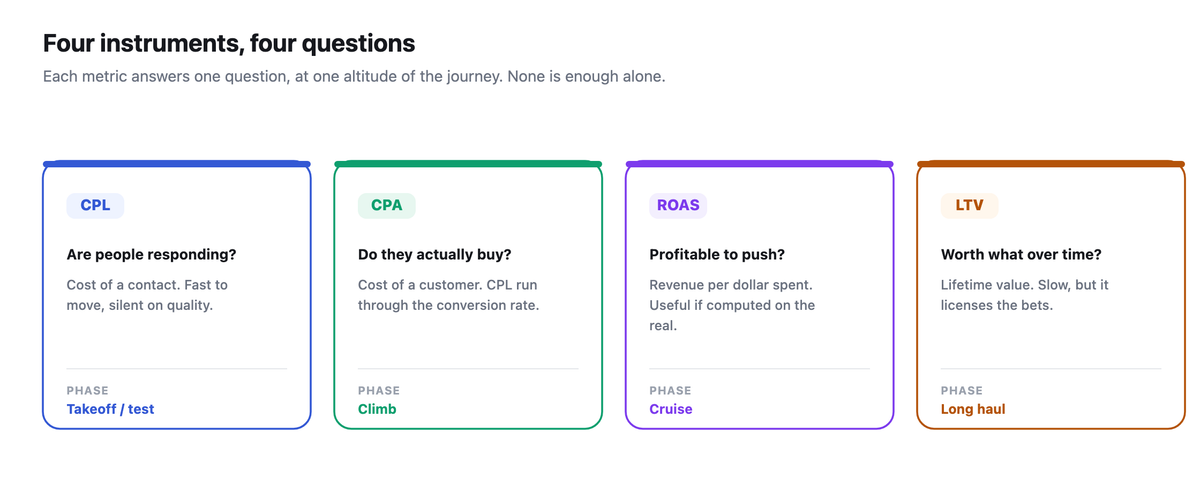
Each metric is an instrument, not a verdict
A dial answers one question, and only one. Mistaking it for the whole panel is flying half-blind.
CPL, cost per lead, answers "are people responding to my ad." How much I pay for a stranger to raise a hand, leave an email, fill a form. It is the fastest instrument to move and the easiest to optimize, which is precisely its danger. A low CPL proves your ad catches attention. It proves nothing about the value of what it catches.
CPA, cost per acquisition, answers "do those people buy." It takes the CPL and runs it through the conversion rate: how much I pay not for a contact, but for a customer who pulls out a card. Between the two sits everything the CPL cannot see, the quality of the lead, the strength of the offer, the sales team's ability to close.
ROAS, return on ad spend, answers "is it profitable to push." Revenue generated per dollar spent. It is the scaling-phase instrument, the one that tells you how far to push the throttle, provided it is computed on real revenue and not on the number the platform grades itself, which is another story, the story of the ROAS that lies.
LTV, lifetime value, answers "what is this customer really worth over time." It is the slowest instrument, the hardest to read, and the only one that lets you pay dearly for an acquisition because you know what it will return over twelve or twenty-four months. Without it, a high CPA looks like a loss when it may be the account's best investment.
Four instruments, four questions, four altitudes. None is sufficient, and that is the first reflex to unlearn.
The instrument lies the moment it becomes the target
Here is the trap, and it has a name in the social sciences. When a measure becomes a target, it ceases to be a good measure. It is Goodhart's law, first stated on monetary policy, and no field illustrates it better than media buying (Strathern, 1997).
Take the four-dollar CPL again. The instant you make it the target, the instant you ask the algorithm and your creatives to drive it down at all costs, the system obeys, but not the way you hoped. To lower the cost of a lead, the simplest path is to go after the cheapest leads, that is the least intentional ones, the curious, the free-magnet hunters, the ones who will never pay. The dial descends beautifully. Quality collapses silently underneath. You optimized the instrument, not the destination.
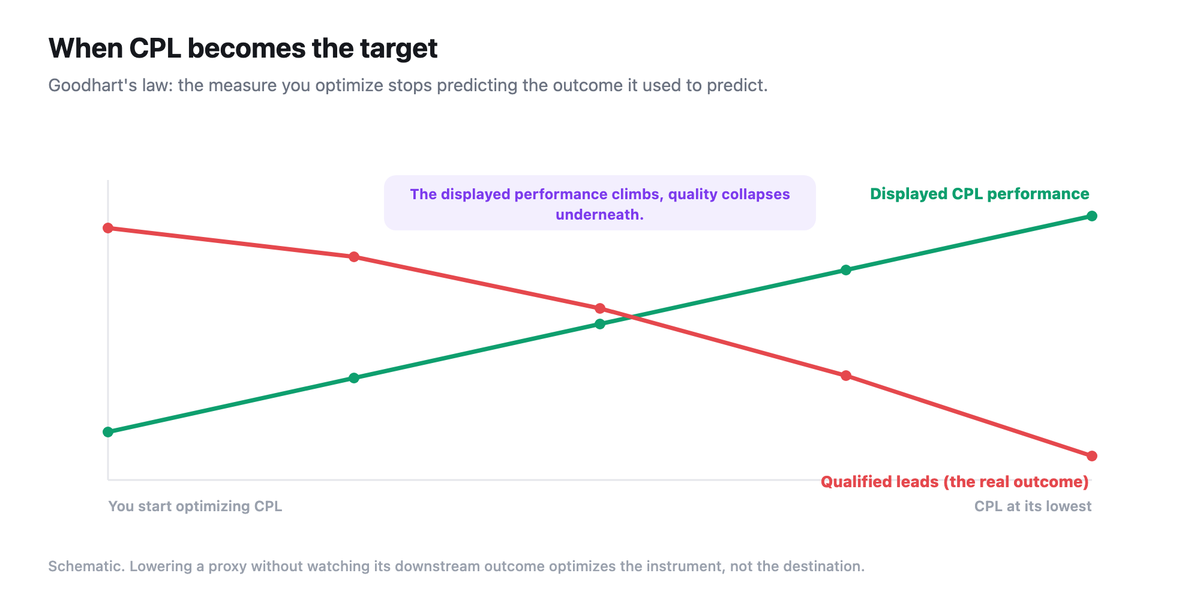
That is why the isolated CPL is the most dangerous instrument in the cockpit: it is the easiest to move, therefore the most tempting to turn into a target, therefore the quickest to lie once it has become one. The rule that protects against Goodhart is simple to state, hard to hold: never fly a proxy without keeping your eye on the outcome it is supposed to predict. A CPL only means something relative to the CPA it produces. A CPA only means something relative to the margin it leaves. The upstream instrument is worth only its fidelity to the downstream one.
Which dial holds the stick, by phase of flight
Good piloting is not choosing one metric forever. It is knowing which instrument leads at which moment, because the question that matters changes with altitude.
On takeoff, when you are testing audiences and angles, watch the CPL. At this stage you do not yet have enough sales for the CPA to be statistically legible, and the honest question is just "does anything catch." The CPL tells you fast. But keep the guardrail: a low CPL on an audience that will not convert is a false positive, to confirm the moment the first sales land.
On the climb, when sales start to accumulate, switch to the CPA. Around fifty sales a month, and the cost per customer becomes reliable. It is the instrument that finally sorts the audiences bringing curious clickers from the ones bringing buyers, and it is the first moment you can honestly compare two channels.
In cruise, when you push budget, the stick passes to ROAS, then margin. Here the only question is "does each extra dollar come back, and with how much margin." ROAS gives you the direction, contribution margin gives you the truth, because a ROAS of three on a low-margin product can ruin you when a ROAS of two on a high-margin product enriches you. This is where the real numbers of your metrics replace appearances.
On the long haul, LTV licenses the bets. When you know a customer's value over time, you can accept a CPA that looks unprofitable on the first purchase because you know it will pay by the third. Without LTV, you leave the market's most profitable acquisitions on the table, the ones your competitors refuse because they read the wrong dial.
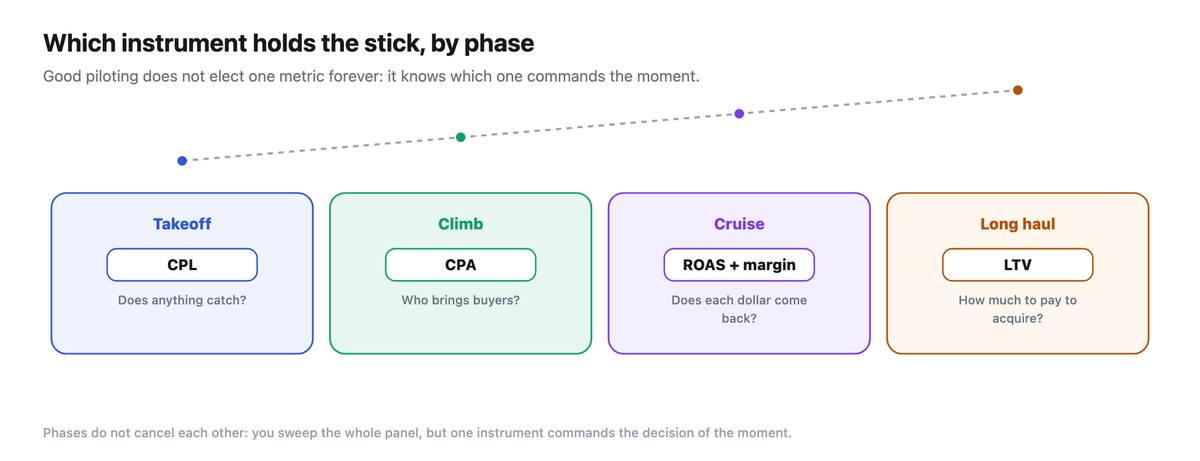
None of these phases cancels the others. A good pilot sweeps the whole panel constantly; he simply knows which instrument commands the decision of the moment.
The one dial that never lies: the cash collected
There remains a hierarchy all these instruments share, and it decides their reliability. A dial is worth only the data feeding it. And CPL, CPA and ROAS are almost always computed from what the ad platform declares, that is an optimistic number, inflated by view-through attribution, cross-channel double counting and modeled conversions. A reported ROAS of four can hide a real ROAS of two, and then your whole piloting rests on a broken altimeter.
The horizon line, the one that does not lie, is the money that actually reached your account. Contribution margin collected, against real spend, deduplicated across channels. As long as your instruments are calibrated on that line, you can trust them. The moment they float on the ad platforms' self-declared figures, you are flying on instruments in fog, and fog always tilts the same way, the way that makes you spend more.
That is exactly the layer Metrikia is built to hold. It pulls spend from Meta, Google and TikTok, ingests real revenue from your store, your CRM and your payments, matches each sale to the campaign that sourced it, and recomputes your CPL, CPA and ROAS on that basis rather than on the platforms' estimates. You do not change instruments. You finally calibrate them on the one thing that decides your survival: the cash collected.
So, which one to fly by
The honest answer is that there is not one, there is one per phase, and a single constant: never follow a dial without watching the one that verifies its promise. CPL without CPA sells you hollow volume. CPA without margin sells you customers at a loss. Reported ROAS without real ROAS sells you a profitability that does not exist. And none of the four, alone, replaces the question only your bank account settles: did that dollar come back, and with what margin.
The pilot who crashed on his four-dollar CPL did not have a bad instrument. He had a good one, which he watched alone. That is the only mistake that truly counts, and it is also the easiest to fix: raise your eyes, read the whole panel, and calibrate it against the ground.
Frequently asked questions
Should I steer by CPL or CPA? By CPL in the testing phase, when you do not yet have enough sales for the CPA to be reliable, and only to check that an audience responds. By CPA as soon as sales volume allows, around fifty a month, because it is the first instrument that separates a curious lead from a paying customer. Never steer by CPL alone in the scaling phase: it is the fastest route to volume that does not pay.
Is ROAS a better metric than CPA? Neither better nor worse, different. CPA thinks in cost per customer, useful when your price is fixed. ROAS thinks in revenue per dollar spent, useful when your basket varies. ROAS becomes misleading if you forget margin: a high ROAS on a thin-margin product can destroy value that a lower ROAS on a high-margin product creates.
Why is my CPL dropping while my sales stall? Because you have probably made CPL a target, and the system went after the cheapest leads, therefore the least intentional. It is Goodhart's law in action: the optimized measure stops predicting the outcome it used to predict. Check the lead-to-sale conversion rate; if it falls when the CPL drops, your CPL is lying.
Which metric to scale a campaign? In cruise, real ROAS then contribution margin, never the platform's reported ROAS. Direction comes from ROAS, truth from margin, and the license to pay dearly for an acquisition comes from LTV. Scaling on an inflated ROAS is accelerating toward a wall.
Is LTV worth calculating when starting out? Yes, even roughly. Without it, you judge each acquisition on its first purchase and refuse the market's most profitable customers, the ones who come back. Even a rough LTV changes what you allow yourself to pay to acquire, and that is often where a durable edge is won over competitors reading the wrong dial.
References
Strathern, M. (1997). "Improving ratings": Audit in the British university system. European Review, 5(3), 305 to 321. https://doi.org/10.1002/(SICI)1234-981X(199707)5:3<305::AID-EURO184>3.0.CO;2-4
Goodhart, C. A. E. (1984). Monetary theory and practice: The UK experience. Macmillan.
Baptiste Noel, co-founder of Metrikia. MSc in Clinical Neuroscience and MSc in High Performance.