
Baptiste Noel
Growth and co-founder of Metrikia
- Master en neurosciences et neuropsychologies cliniques
- Master en entraînement et optimisation de la performance
- Créateur SaaS et de contenu, 20 000+ abonnés LinkedIn
Co-founder of Metrikia, Baptiste is building a SaaS from scratch and shares the growth journey unfiltered. A former clinical-neuroscience researcher and physical-performance coach, he built then left a coaching business generating over 70,000 EUR per month before focusing on product. He writes about growth strategy, acquisition and scaling.
LinkedInAdvantage+ Killed Targeting. Here's How to Actually Use It (and Where It Burns You)
The honest Meta Advantage+ playbook for 2026: how to set it up and feed it, its real frustrations and limits, and when manual campaigns still win.
There is a word that, spoken out loud in an agency in 2026, freezes every media buyer in the room. Advantage+. The Voldemort of media buying, He Who Must Not Be Named: the feature that took the wheel without asking, and that half the profession blames for killing its craft.
The phobia is not irrational. In February 2026, Meta merged the manual and Advantage+ flows into a single interface, with AI optimization checked by default on every new sales campaign. Ten years of expertise in audiences, placements and bids became, overnight, optional. The wheel is still on the screen. It just is not connected to much anymore.
Except the fear comes mostly from misunderstanding. Fed well, Advantage+ genuinely lowers your cost per purchase. Misunderstood, it crops your logos, replaces your best ads with weird generated versions, and burns budget on customers you already had. What follows is not a Meta brochure, it is the honest manual: how to set it up and feed it so it performs, what its real frustrations are and how to defend against them, and when to take the wheel back by hand.
What is Meta Advantage+?
Advantage+ is Meta's suite of AI-automated campaigns. Instead of defining audiences, placements and budget splits yourself, you set an objective and a budget, you supply your creatives, and the algorithm decides who, where and when to show them. Its flagship e-commerce version, Advantage+ Shopping (ASC), handles acquisition and retargeting inside a single campaign. Since early 2026, this mode is the default for every new sales campaign.
The shift is not cosmetic. It moves the power. Before, your value as a media buyer sat in your ability to find the right audience. Today that decision belongs to the machine, and to a specific machine: Meta's retrieval engine, Andromeda.
On the menu:
- The real change: why your creative became your targeting.
- The only levers you have left, and how to hold them.
- How to feed the machine: creatives, budget, prerequisites, structure.
- The real frustrations with Advantage+, and how to defend against each.
- When to close Advantage+ and take the wheel back by hand.
The real change: your creative became your targeting
Here is the mechanism nobody explains clearly, and it governs everything else. Andromeda, the engine that decides which ad to show to whom, no longer reads your audience settings first. It reads your creative. The visuals, the hook, the theme, the language used in the ad become the primary signal for choosing its audience. In plain terms, you no longer tell Meta "show this to women aged 25-34 interested in yoga." Your creative tells Meta, all by itself, who it speaks to, and Meta carries it to those people.
The consequence is brutal and freeing at once. Tinkering with audiences barely matters anymore. Your performance lever, the one that will actually move your numbers, has shifted entirely onto the creative. The media buyer still spending their days slicing interests is working a wheel that is unplugged. The one spending their days producing and testing creative is holding the only wheel that still responds.
The only levers you have left
Advantage+ does not leave you naked, it leaves you with little. Put all your attention on what still moves, and let go of the rest.
- Creative volume and mix. This is lever number one, by a wide margin. More on it right after.
- The budget floor. The algorithm needs enough daily spend to learn. Below a certain threshold, it never exits its learning phase.
- The existing-customer cap. ASC blends acquisition and retargeting. Without a guardrail, it will chase the easy conversion among people who were going to buy anyway. Cap the budget share going to existing customers at 10 to 20 percent, to force the machine to bring in new buyers.
- Exclusions. Exclude your recent buyers, your irrelevant audiences. This is the little targeting that still counts, targeting by subtraction.
- Cost controls. Setting a cost-per-acquisition goal guides the algorithm without shackling it the way manual targeting used to.
Everything else, ages, interests, manual placements, you can let go. Not because thinking became useless, but because at this scale the machine now does it better than you.
How to feed the machine
Since creative is the targeting, your job becomes a creative factory job. Here are the settings that work, drawn from the accounts performing in 2026.
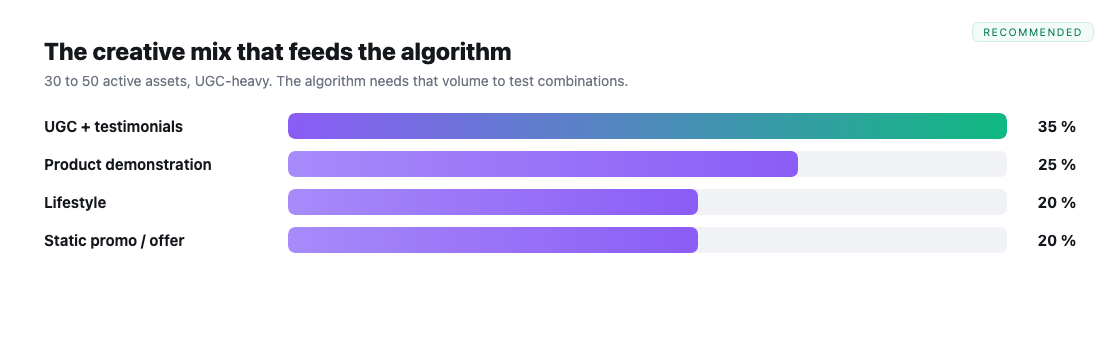
Volume. The algorithm needs material to test combinations. Count on 30 to 50 active assets, mixing static, video and UGC. Too few creatives, and Andromeda has nothing to optimize.
Mix. The split that recurs among big spenders: 30 to 40 percent UGC and testimonials, 20 to 30 percent product demos and "how it works" videos, 15 to 25 percent lifestyle. UGC dominates because it is the format the algorithm places most effectively on cold audiences.
Budget. You have to feed enough to generate one or two purchases a day, otherwise the campaign never learns. The technical floor sits around 50 dollars a day, the practical floor around 100. Count on 150 to 300 dollars a day for a small-to-medium store, and 500 to 2,000 and up for an established brand.
| Profile | Budget per day | What it unlocks |
|---|---|---|
| Technical floor | $50 | 1-2 purchases a day, bare minimum |
| Practical floor | $100 | exits the learning phase |
| Small-to-medium store | $150-300 | stable learning |
| Established brand | $500-2,000 and up | scaling |
Prerequisites. ASC gives its best on an already mature account: roughly 50 purchases a week, a catalog of 30 SKUs or more, a pixel paired with the Conversions API, and products with a short purchase cycle, typically under 200 dollars. Below that data threshold, the algorithm lacks signal and flounders.
Structure. Resist the urge to stack campaigns. Most accounts perform better with one or two ASC campaigns, one for the core catalog, maybe a second for a product line or a promo. Multiplying campaigns over overlapping audiences only puts you in competition with yourself.
Patience. Let it run 7 to 14 days before judging. Advantage+ learns slowly, and the most common mistake is cutting everything at three days on a number that has not finished stabilizing.
The real frustrations, and how to defend against each
This is the part sponsored guides avoid. Advantage+ has documented flaws, some serious. Knowing them is half the defense.
It mangles your creatives. The most-cited complaint. Advantage+'s creative "enhancements" crop your images and cut off your logos, slap unapproved music on your statics, rearrange your text against your brand guidelines. Worse, the system sometimes replaces a winning ad on its own with an AI-generated version that misses your brand entirely. The defense: review the creative enhancements one by one and turn off the ones you do not want. Never leave creative automation on "all checked" for assets where your brand image matters.
It is a black box. Advantage+ tells you which ad performed best, rarely why. Because dozens of variables are optimized at once, it becomes hard to pinpoint what moved your results. For a team that learns through structured testing, that is a real drag. The defense: keep a minimal, readable structure, name your assets cleanly, and above all measure creative performance from a source outside Meta, not only from Meta's own report.
It cannibalizes itself. An auction overlap report on campaigns using the same audience with different signals can show 99 percent audience overlap for less than 1 percent auction overlap. Translation: your campaigns are fighting over the same people without seeing it. The defense is consolidation. One or two campaigns, not ten.
It reports fake leads. On lead-generation objectives, the "these people never filled out my form" complaint became systemic in early 2026, a direct effect of an algorithm prioritizing volume over intent to make its own results look good. The defense: harden qualification upstream, and judge on real qualified leads, not on Meta's counter.
It turns itself back on. Several automations activate by default and sometimes re-enable after being switched off. The defense: audit your settings regularly, rather than assuming a toggle stays off.
When to close Advantage+ and go back to manual
Advantage+ is not a religion, it is a tool with a domain of validity. No serious media buyer puts 100 percent of their budget in it. Manual keeps the edge in several precise cases.
When your account is too small or too slow: fewer than 50 purchases a week, high basket, long purchase cycle. The algorithm lacks signal and gets it wrong. When you want surgical precision: VIP retargeting, reactivating a named segment, entering a new market to test cleanly. And when you validate a creative concept: to know whether a new creative holds up, a controlled manual test gives you a clear read that Advantage+'s black box never will. The dominant best practice in 2026 stays hybrid: you identify the winning creatives in manual or a clean test, then hand them to Advantage+ to scale.
The one judge you must not delegate to Meta
One truth remains, and it decides all the rest. Advantage+ grades its own homework. It chooses your audiences, executes your budgets, and scores its own performance, with attribution rules that favor it. According to Meta's internal data, ASC lowers cost per purchase by about 10 percent versus a standard campaign. Maybe. But Meta is the one holding the number.
To know whether Advantage+ actually pays, and not just whether it claims your sales, you need an outside judge: reconcile what it claims against the cash actually collected, and validate the big moves with an incrementality test. That is the job of an independent attribution layer like Metrikia, which ties each campaign to real revenue and tells you whether the machine creates value or simply harvests what already existed. Say its name, hand it the wheel. But keep the meter: it is the one thing Advantage+ must never grade for itself.
In three sentences
Since February 2026, Advantage+ is the default, and it moved your lever from audiences to creative: your creative is now what targets. Feed the machine 30 to 50 varied creatives, hold the few controls that remain, turn off the enhancements that mangle your assets, and consolidate to avoid cannibalization. Hand it the execution, but measure its real contribution from a source outside Meta, because it grades its own homework.
FAQ
Should I put all my budget on Advantage+? No. No experienced media buyer does. The dominant approach in 2026 is hybrid: Advantage+ to scale winning creatives, manual for precision, VIP retargeting, new markets and concept validation. The right split depends on how mature your account is.
Why are my ads being modified without my approval? Those are Advantage+'s creative enhancements, on by default. They crop, add music, rearrange text, and sometimes replace a creative with a generated version. Review each enhancement and turn off the ones you do not want, especially on assets that matter for your brand.
How many creatives does Advantage+ need to work? Count on 30 to 50 active assets, mixing static, video and UGC, with a UGC-and-testimonial lean. The algorithm needs that volume to test combinations. Refresh regularly to avoid creative fatigue.
Does Advantage+ cannibalize my other campaigns? Yes, if you stack campaigns over overlapping audiences. A high auction overlap means your campaigns are fighting over the same people. The fix is consolidation: one or two ASC campaigns, with clean exclusions.
How do I know if Advantage+ is actually profitable? Not by trusting its report, since it attributes to itself. Reconcile what it claims against the revenue actually collected, and validate its incrementality with a geo test or a holdout. An independent attribution layer tells you whether it creates value or harvests what already existed.
What is the minimum budget for Advantage+? Count on a technical floor around 50 dollars a day to generate one or two purchases daily, and a practical floor around 100 dollars to exit the learning phase. Below that, the campaign never learns and the budget is wasted.
Advantage+ Shopping vs Advantage+ Sales, what is the difference? Advantage+ Shopping (ASC) is the e-commerce, catalog-driven version that merges acquisition and retargeting. Advantage+ Sales is the generic sales objective, without a catalog. For a store with a catalog of 30 SKUs or more, ASC is usually the right choice.
What is Andromeda at Meta? Andromeda is Meta's retrieval engine: it encodes each creative (visual, hook, text) into a vector and matches it to the predicted behavior of profiles. It is why your creative, not your audience settings, now decides who sees the ad.
References
Meta. Advantage+ Shopping Campaigns. Meta for Business. https://www.facebook.com/business/ads/meta-advantage/advantage-plus-shopping-ads
Meta. About Advantage+ shopping campaigns. Meta Business Help Center. https://www.facebook.com/business/help/
Baptiste Noel, co-founder of Metrikia. MSc in Clinical Neuroscience and MSc in High Performance.