
Baptiste Noel
Growth and co-founder of Metrikia
- Master en neurosciences et neuropsychologies cliniques
- Master en entraînement et optimisation de la performance
- Créateur SaaS et de contenu, 20 000+ abonnés LinkedIn
Co-founder of Metrikia, Baptiste is building a SaaS from scratch and shares the growth journey unfiltered. A former clinical-neuroscience researcher and physical-performance coach, he built then left a coaching business generating over 70,000 EUR per month before focusing on product. He writes about growth strategy, acquisition and scaling.
LinkedInSteal What Works: The E-commerce Ads That Win in 2026, Niche by Niche
The swipe file of e-commerce ads that sell in 2026, niche by niche: beauty, supplements, fashion, home, fitness. The winning angles, the brands, ready to copy.
In 2026, advertising on Meta has little in common with the job it was five years ago. Winning used to mean finding the right audience: the right interests, the right lookalike, the right age split. Today the algorithm picks the audience by itself, from your creative. The playing field has moved. It is no longer about targeting, it is about producing the right creative, at volume.
AG1 is the perfect illustration. This supplement brand, valued at over a billion dollars, no longer tells Meta who to target in the settings. It tells it in the creative. Same product, same offer, but each variant sends a different signal to the algorithm: this video whispers "find me dads," that one "women who run," a third "people obsessed with their gut health." To cover all those signals, AG1 keeps around 245 ads live at any time, more than 5,400 creatives produced in total, and ships roughly 64 new ones every week. At AG1, the creative does not serve the campaign. It teaches Meta who to go find.
And here is the good news for you. That machine leaves a trail. Every winning ad that runs for months is public, visible to everyone in the ad library. Agencies have torn down thousands of them, niche by niche, measured their lifespan, isolated the formats that survive when the average dies in a few weeks. You do not have to guess what works. You can read it, and copy it. Here is the swipe file: five e-commerce niches, and for each the angles that win, the mechanism that explains why, the brands that run them, and the most duplicable tactic for a small budget. One last word before we dive in: always check in the Meta Ad Library that an ad is still running before you draw from it, a dead creative proves nothing.
What is a winning ad in 2026?
A winning ad in 2026 is UGC-native (filmed on a phone, not in a studio), carried by a single clear benefit rather than a list of arguments, with a hook in the first three seconds, and it sells the usage process rather than a promised result. That last point is not a style choice: since 2026, Meta restricts before-and-after imagery, including implicit versions, and pushes proof toward mechanism and quantified social proof. The creative, finally, is the targeting: each variant tells the algorithm who it speaks to.
Keep these four invariants in mind, they come back in every niche. On to the field.
On the menu:
- Beauty and skincare: the real-time demo, undisputed queen.
- Supplements and health: the founder, the mechanism, and patience.
- Fashion and apparel: the try-on that kills fit anxiety.
- Home: the silent demo and "buy it once."
- Fitness and wellness: the peer, the process, and the death of before-and-after.
- The five laws that win in every niche.
The full map, to steal at a glance, before the niche-by-niche detail:
| Niche | Killer angle | Winning format | Benchmark brand | The "steal this" |
|---|---|---|---|---|
| Beauty | Real-time demo | UGC close-up texture | Youthforia | 1 creator, 1 phone, 1 benefit |
| Supplements | Founder + mechanism | Talking head 30-45s | AG1, Seed | 3-5 variants, keep the winner |
| Fashion | Fit-anxiety try-on | UGC try-on + counted proof | Vuori, Mejuri | 3 hooks x 3 bodies x 3 CTAs |
| Home | "Buy it once" | Silent / ASMR demo | HexClad | Locked copy, vary the visual |
| Fitness | Peer + process | UGC testimonial + benefit-stack | Gymshark | 5-beat arc, 15-20 assets/month |
Beauty and skincare: the real-time demo is queen
In an analysis of 500 top-performing beauty ads, the demonstration-plus-UGC combination makes up the vast majority of the creatives with the longest lifespan. The king format is the raw video where the product is applied live: the texture, the absorption, the color changing on the skin. The data is clear: UGC video alone accounts for more than a third of the winners, far ahead of image and pro video.
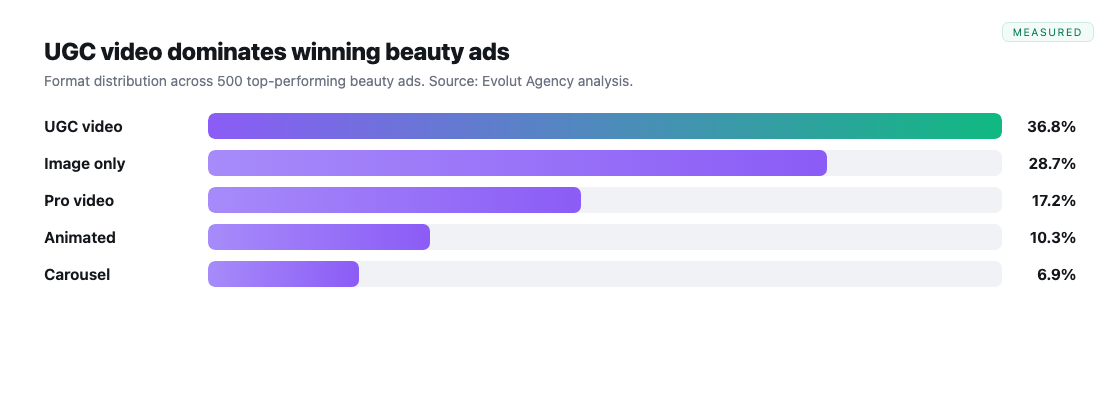
The mechanism is specific to beauty. It is a purchase of high sensory uncertainty: what texture, what shade, what result on MY skin. The real-time demo removes that costly mental simulation by making it observable, it transfers proof from the verbal to the perceptual. UGC adds a signal of social similarity that lowers the viewer's guard, where the polished pro video triggers the "this is an ad" reflex. Second verified law: creatives that hold a single hero benefit last far longer than multi-claim ones.
Youthforia embodies it at the top, with winning creatives whose average lifespan tops 600 days, built more than 80% on product demonstration (a blush that changes color applied live) and a minimal CTA. Topicals pushes texture and transformation TikTok-style, with the vast majority of its ads pointing straight to the product page and its thousands of reviews as proof. Hey Bud holds ads past 600 days on a simple skeleton: problem, demo, light CTA.
Steal this: a 20-to-30-second UGC demo, a single benefit hammered home, close-up texture on real skin, direct link to the product page. One creator, one phone, natural light. No studio, no compliance-risky before-and-after.
Supplements and health: the founder, the mechanism, patience
This is the niche where winning creatives live longest, often more than a year. The reason is cognitive: ingesting a product engages the body, risk aversion is maximal, and the decision is slow. Counterintuitive strategic consequence: you do not iterate fast here, you find a winner and keep it alive.
Three angles dominate. The founder or expert talking head, because a face that puts its name on the product triggers a transfer of authority and responsibility. The authority hook, quantified and verifiable ("backed by twelve studies," a precise dose), because precision itself is a signal of competence. And the demonstration of the mechanism of action, "here is how it works in the body," which creates causal plausibility where the benefit is invisible and delayed. That last one is also the safest for compliance, in a niche where nearly one ad in three is rejected before it runs.
AG1, met in the intro, does not only pilot its targeting through creative. On the message side, its whole communication rests on a single pain point, "supplement fatigue," the weariness of managing twelve pills, and sells simplification over performance. Its flagship offer is a "Free Welcome Kit," a bundle of gifts with an anchored value rather than a discount, pure price-anchoring. Ritual plays radical transparency, transparent packaging and full ingredient disclosure. Seed makes science its creative, with clinical data and its acid-survival technology explained on screen.
Steal this: a 30-to-45-second founder or expert talking head, authority or contrarian hook, immediately followed by the "how it works" mechanism. Produce three to five variants, find the winner, and do not kill it too fast.
Fashion and apparel: the try-on that kills fit anxiety
In fashion, the number-one objection is not price, it is uncertainty about the real result: the real body is not the studio model. Hence the dominance of the UGC try-on, a real person putting the garment on and answering the fit question live. The prospect's brain does a proxy try-on on a body that resembles its own, which defuses the fear of return and disappointment. White-background studio shots are scrolled past precisely because they lift no uncertainty.
Two other levers carry the niche. The visual coherence of the first three seconds, because in fashion the visual identity is the product and instantly signals belonging to a tribe. And quantified social proof on screen, a customer counter, a star rating, which turns a risky taste decision into a herd-validated choice.
Vuori sells "wear it for everything," a category reframe that widens the usage occasion beyond the gym, on a machine of more than a thousand active creatives. Mejuri opens its jewelry ads on a precise counter, "over 20,000 customers," and a visible star rating. SKIMS barely runs traditional ads: a coordinated network of creators and customers tells the brand, which is the textbook case of "the creative is the targeting."
Steal this: the objection-first UGC try-on, spun into a matrix of three hooks, three video bodies, three CTAs. One shoot yields nine to eighteen variants, you let the algorithm find the winner. Real person from the first frame, native subtitles, a voice or music.
Home: the silent demo and "buy it once"
Home is bought online without being able to touch, yet it is a sensory, tactile category. The winning format answers exactly that gap: the purely visual product demonstration, often without voice, sometimes ASMR, where the product does its job on screen (the non-stick glide, the storage that clicks, the satisfying stack). It is the only e-commerce niche where satisfying audio recurs in the winners, and the format holds without sound, which matters when most of the feed is watched in silence.
The dominant verbal angle is "buy it once." You do not sell a product, you sell the end of a repurchase cycle. The framing activates loss aversion, the pain of the cash already burned on cheap stuff replaced every year, more powerful than the desire to acquire, and the lifetime warranty closes the loop by de-risking the high price.
HexClad is the industrial demonstration of all this. Gordon Ramsay carries a large share of the creatives, the "buy it once" angle and the lifetime warranty are everywhere, and above all the system is locked: fixed copy, only the visuals vary, around two hundred ads live at all times, sprints of a hundred and fifty creatives a week, a fourteen-day test cycle then recirculation of the winners. Caraway tests color, format and landing page at a granular level by segment. Matt Sleeps, on sleep, works in a problem-solution sequence because a mattress is bought out of pain, not aesthetics.
Steal this: a satisfying visual product demo filmed on a phone, a three-to-five-second silent hook, on copy locked to the "buy it once" angle. Vary only the visual, five to ten variants on one script, and spin the best one into a UGC "I can't live without it" version in a real home.
Fitness and wellness: the peer, the process, the death of before-and-after
Here is the niche that moved the most in 2026, and the change is regulatory. Meta restricted before-and-after imagery, including implicit transformations (a product placed next to an athletic person is now treated as a before-and-after), and imposes disclaimers on health claims. The niche's historically strongest angle is dead. Proof had to migrate from the bodily result to the usage process and quantified social proof.
As a result, the winners all exploit the same shift. The peer-to-peer UGC testimonial, which short-circuits skepticism (high here, after years of abandoned diets and apps) by replacing a brand source, discounted by default, with a peer source seen as disinterested. The cadenced usage demo, the "here is what happens in 30 seconds" template followed by a benefit stack, which makes the product concrete and dodges the censorship of results. And the outcome-first static at near-zero cost, phrased "wake up not sore" rather than "magnesium 400 mg," because the brain buys a future state, not an ingredient.
Gymshark is the archetype, with a very high-volume UGC-first playbook, tens of thousands of tracked creatives, and insider hooks in spoken slang like "It's leg day babies…". AG1 concentrates nearly 59% of its portfolio on the single "30-second hook plus benefit-stack" template. Seed and Supergut play education and temporal anchoring, "feel better in two weeks."
Steal this: a UGC iPhone "real use plus specific micro-result," on the five-beat arc (hook, problem, easy solution, social proof, CTA). Say "six weeks and my back no longer wakes me up," never "it changed my life." The specific is believed, the superlative is discarded. Fifteen to twenty assets a month, refreshed every four to six weeks.
The five laws that win in every niche
You have seen them recur. Here is what stays true everywhere, whatever the product.
- UGC beats studio. Filmed on a phone, imperfect, by a peer. Social resemblance lowers the guard that polished ads raise.
- A single benefit beats the list. Single-message creatives last longer in every niche. Multi-claim dilutes and fatigues.
- The first-three-seconds hook is a blind spot. Very few advertisers really nail it, which makes it the easiest edge to grab.
- The creative is the targeting. Each variant signals a segment to the algorithm. Producing creative diversity is how you steer Advantage+.
- Find a winner, then feed it. The longevity of the best ads does not come from a perfect creative, but from the volume of upstream testing, followed by patience once the winner is found.
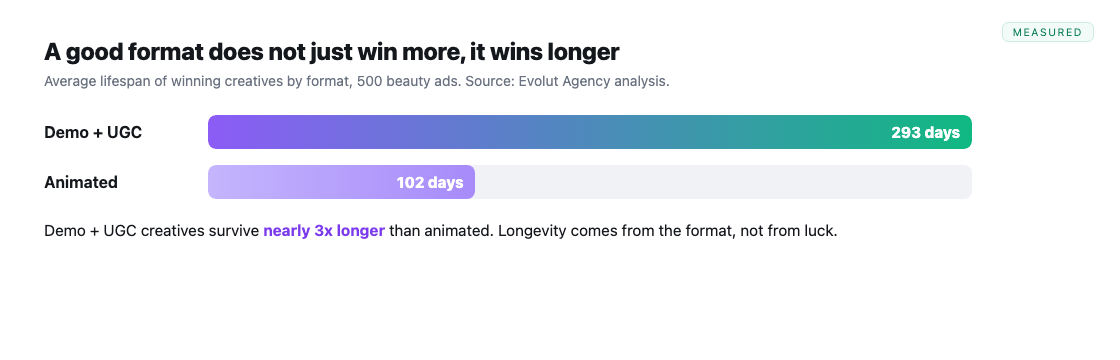
This last point is not intuition, it is measurable. On those same 500 beauty ads, Demo-plus-UGC creatives held for an average of nearly 293 days, against about 102 days for animated, almost three times longer. A good format does not just win more, it wins longer.
The one thing this swipe file will not tell you
This catalog tells you what wins in general, in your niche. It does not tell you which of YOUR creatives, once launched, actually brought in cash. An ad can tick every winning pattern, rack up clicks, and still be a budget sieve. The only way to know is to tie each creative to the revenue actually collected, not to the platform's clicks or views. That is the job of an attribution layer like Metrikia, which ties each ad to real revenue and tells you which one to scale. The swipe file gives you the right bets. Attribution tells you which ones paid.
In three sentences
In 2026 the creative is your targeting, and you do not have to guess what works: the winners are already torn down, niche by niche. Everywhere the same laws recur, UGC over studio, a single benefit, a hook in three seconds, the creative as targeting, but each niche has its killer angle, from the real-time demo in beauty to "buy it once" in home. Copy your niche's pattern, produce at volume, and measure against real cash which one to scale.
FAQ
Does copying competitors' ads actually work? You do not copy an ad, you copy a winning pattern validated by its run time. The angles and formats in this article are documented across thousands of creatives. The right method: take the skeleton that wins in your niche, run it with your product and your voice, then test at volume.
Which format works best, across all niches? UGC video filmed on a phone, with a single hero benefit and a hook in the first three seconds. It wins everywhere because social resemblance lowers the distrust that studio ads trigger. Then spin it into outcome-first statics at near-zero cost.
Why do my before-and-afters no longer pass in fitness or beauty? Because Meta restricted before-and-after imagery in 2026, including implicit versions. The fix is to move proof from the result to the usage process and quantified social proof (reviews, stars, customer counts), which are both more credible and compliant.
How many creatives should I produce? Enough for the algorithm to have material to test: count on fifteen to twenty assets a month, refreshed every four to six weeks, on one or two winning angles spun out. Longevity comes from the volume of testing, not from finding the perfect creative on the first try.
What is a swipe file in advertising? A swipe file is a collection of winning ads you keep as reference to draw from. In 2026, the best swipe file is public and free: the Meta Ad Library, where every active ad is visible, with its run time as a performance signal.
How do I find my competitors' winning ads? Open the Meta Ad Library, type the brand, filter to active ads, and spot the ones running for 90 days or more. Nobody pays to run a losing ad, so those survivors are your winners to break down.
How long does a winning creative stay live? It depends on the niche. In supplements, the best ones often run over a year. In beauty, Demo-plus-UGC creatives hold for about 293 days, against 102 for animated. A long run time is the most reliable signal of a winner.
Which angle works best in my niche? See the table at the top of the article: real-time demo in beauty, founder plus mechanism in supplements, try-on in fashion, buy-it-once in home, peer plus process in fitness. Everywhere, UGC video and the first-three-seconds hook come out on top.
References
Evolut Agency. We Analyzed 500 Top Beauty Ads / 500 Top Supplement Ads. https://evolutagency.com/2026-top-beauty-ads-intelligence-report/
Motion. Creative playbooks: HexClad, Caraway, Matt Sleeps. https://motionapp.com/blog
GoMarble. Brand ad libraries: Vuori, Gymshark, Athletic Greens. https://www.gomarble.ai/library/brands/
AuditSocials. (2026). Meta Health & Wellness Restricted Ads 2026. https://www.auditsocials.com/blog/meta-health-wellness-restricted-ads-2026-supplements-body-image-medical-claim-rules
Meta. Ad Library. https://www.facebook.com/ads/library/
Baptiste Noel, co-founder of Metrikia. MSc in Clinical Neuroscience and MSc in High Performance.