
Baptiste Noel
Growth and co-founder of Metrikia
- Master en neurosciences et neuropsychologies cliniques
- Master en entraînement et optimisation de la performance
- Créateur SaaS et de contenu, 20 000+ abonnés LinkedIn
Co-founder of Metrikia, Baptiste is building a SaaS from scratch and shares the growth journey unfiltered. A former clinical-neuroscience researcher and physical-performance coach, he built then left a coaching business generating over 70,000 EUR per month before focusing on product. He writes about growth strategy, acquisition and scaling.
LinkedInThe Secret Skeleton of an Ad That Sells (Written by 6 Advertising Legends)
The anatomy of a high-converting ad: the five timeless parts codified by Ogilvy, Hopkins and Bernbach, and how to tell if yours actually sells.
In 1926, a young copywriter at a New York agency scribbles one line for a mail-order piano school. No image, no production budget, a single sentence: "They laughed when I sat down at the piano, but when I started to play!"
The ad triggers a record flood of order coupons. The copywriter was John Caples. A century later, brands burn fortunes on production, actors and editing, and still cannot beat the structure of that one sentence.
That is the secret the average blog about creative will never tell you, because it thinks the craft was invented alongside Ads Manager. An ad that sells has an anatomy. A skeleton. And that skeleton has not moved since Claude Hopkins was counting his coupons in the 1920s. What changes, from a magazine page to a vertical TikTok, is the skin.
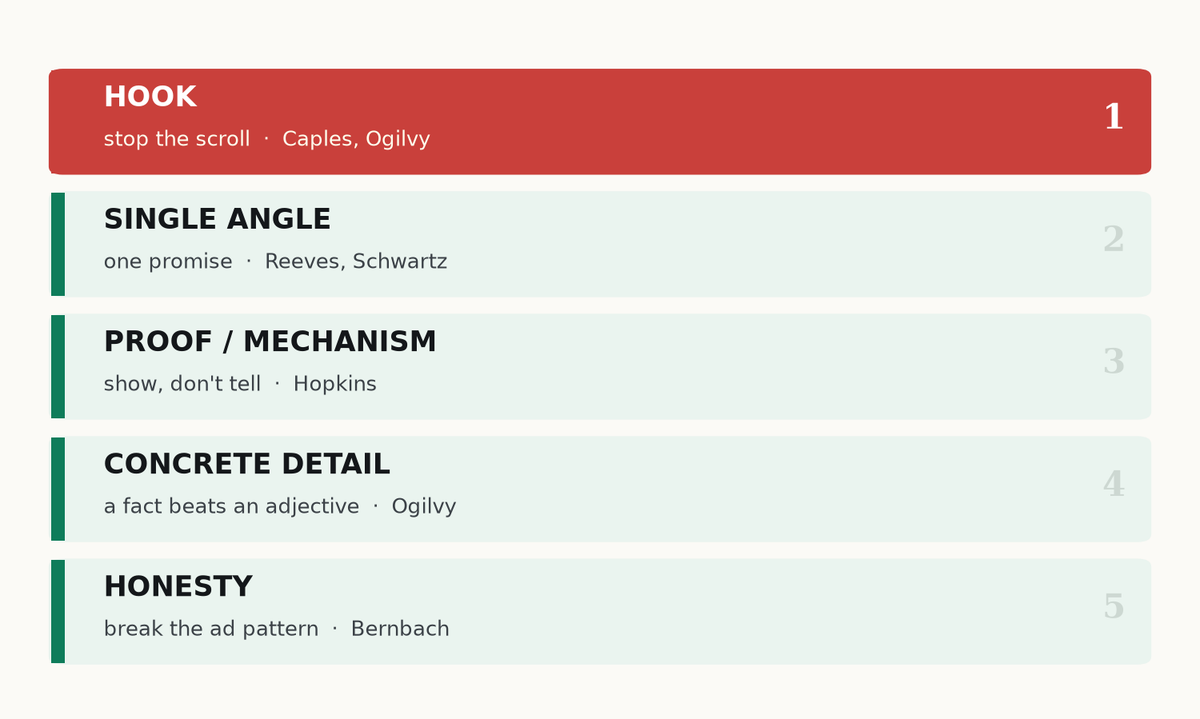
A high-converting creative rests on five parts of anatomy: a hook that stops the scroll, a single angle, proof through the mechanism, a concrete detail that replaces adjectives, and an honesty that breaks the advertising pattern. The format changes, these five bones do not. Measuring them honestly is another craft, and it is where most people lie to themselves.
On the menu
- Why a 1926 sentence still converts better than your last $5,000 production.
- The 5 bones of the skeleton, each proven by a legend and a landmark case.
- The hook: where 80% of your money goes, according to Ogilvy himself.
- How Schlitz went from 5th to 1st by showing what everyone else hid.
- Why your hook rate lies to you, and what Hopkins already understood.
The Skeleton and the Skin
Take any ad that truly sold, a 1923 print piece or a 2026 vertical video, and run it through an x-ray. Under the skin, always the same frame. One bone to capture, one to promise, one to prove, one to anchor, one to disarm.
The skin, meanwhile, molts constantly. Yesterday a full black-and-white page, today nine seconds shot on a phone, sound off, captions burned in. The average media buyer spends their days on the skin: the format, the edit, the trend of the moment. They keep repainting a body panel and wonder why it will not drive. The problem is almost always underneath, in a missing bone.
The legends did not invent rules. They x-rayed what already worked and wrote it down so we would stop guessing.
The Hook: 80% of Your Money Rides on the First Second
David Ogilvy put a number on what Caples had felt. His most quoted line is also the most ignored in practice.
"On the average, five times as many people read the headline as read the body copy. When you have written your headline, you have spent eighty cents out of your dollar." (David Ogilvy, Confessions of an Advertising Man, 1963)
Transpose it to 2026. The headline has become the first second of your video. Media buyers call it hook rate, or thumbstop: the share of people who watch at least three seconds, divided by impressions. Below 20%, your ad is dead before it speaks. Above 30%, it has earned the right to exist. Eighty cents of your dollar are decided there, exactly as Ogilvy said, except the headline now lasts three seconds and has no sound.
Landmark case: Caples, 1926. "They laughed when I sat down at the piano..." does not sell a piano. It opens a loop. You want to know what happened when he started to play. That curiosity is the thumbstop before the scroll was invented. Caples turned it into a whole method of testing in Tested Advertising Methods (1932): never trust your taste, test hook against hook. The creative split-test you think is modern is nearly a hundred years old.
The operating lesson: test your hooks separately from the rest. Five to ten openings for the same ad body. It is the highest-return lever in media buying, and it is pure Caples.
The Single Angle: One Promise, Not Ten
Once the scroll stops, the creative must say one thing. Rosser Reeves gave the idea its battle name: the USP, the unique selling proposition.
"Each advertisement must make a proposition to the consumer: buy this product, and you will get this specific benefit. The proposition must be one the competition cannot or does not offer. And it must be strong enough to move the masses." (Rosser Reeves, Reality in Advertising, 1961)
His landmark case fits in a line everyone knows without knowing where it came from: M&M's "melts in your mouth, not in your hand." One benefit, concrete, that nobody else was claiming. Today, the creative that stacks three promises into ten seconds does not convert: it dilutes. One ad, one idea.
Eugene Schwartz added the nuance missing from every modern tutorial. The right angle depends on where your prospect already is. In Breakthrough Advertising (1966), he describes five states of awareness, from unaware of the problem to fully informed. A new market is happy with a simple promise. A saturated, skeptical market demands a new mechanism, a reason to believe that this time is different. That is why the same pair of shoes needs a radically different hook depending on whether it speaks to someone just discovering foot pain or someone who has already tried six brands.
Proof Through the Mechanism: Show What Others Hide
Promising is not enough. You have to give a reason to believe. And the absolute master of proof is the man who, separately, invented measurement: Claude Hopkins.
"The only purpose of advertising is to make sales." Advertising, he wrote, is nothing but salesmanship multiplied, and must be judged by the sales it brings in. (Claude Hopkins, Scientific Advertising, 1923)
Landmark case: Schlitz. Hopkins toured the brewery and found a purification process every brewer used but none advertised: bottles washed with live steam, water from deep artesian wells, filtered air. He built the whole campaign on it. The product did not change, only the demonstration of the mechanism did. Schlitz reportedly went from fifth to first in the market within months. Note: this result comes from Hopkins's own memoir, not from audited market data. The lesson, though, is solid.
That is exactly what good UGC creative does today: it shows. The product in hand, the demo, the before-and-after, the real gesture. Not "our cream works," but the texture sinking in, filmed up close. Schwartz called it introducing a new mechanism. Hopkins called it reason-why. Your best demonstration ads are Hopkins with an iPhone.
The Concrete Detail: One Fact Kills a Thousand Adjectives
There is a difference between saying a car is quiet and proving it in one image. Ogilvy wrote it for the ages.
Landmark case: Rolls-Royce, 1958. "At 60 miles an hour the loudest noise in this new Rolls-Royce comes from the electric clock." Ogilvy wrote over a hundred headlines before keeping that one, which he had in fact borrowed from a road test in The Motor magazine. By his own account, U.S. sales jumped about 50% the following year. The word "quiet" appears nowhere. The silence is proven by a verifiable detail: the clock.
The rule is timeless and brutal: a concrete fact converts better than a pile of adjectives. "Fast shipping" is worthless. "At your door Tuesday" sells. In a video, it becomes the precise number on screen, the tight shot on the exact gesture, the literal demonstration. Adjectives, the brain ignores. Facts, it keeps.
Honesty: Breaking the Advertising Pattern
The last bone is the most counterintuitive. In a feed saturated with perfect promises, the thing that truly stops you is the admission. Bill Bernbach made it a revolution.
"Good taste, good art, good writing can be good selling." (William Bernbach, 1947)
Landmark case: Volkswagen, "Think Small" (1959) and "Lemon" (1960). In the middle of an America selling huge, gleaming cars, DDB showed a small Beetle on a white background, and dared to headline "Lemon" on one of its own cars, pulled by quality control. The anti-ad. Candor as a pattern break. Ad Age named it the best campaign of the 20th century in 1999.
Translation for 2026: the ad that does not look like an ad. The native tone, the owned flaw, the "we are not for everyone." This is not false modesty, it is a pattern interrupt. In a feed where everyone shouts that it is perfect, the one who admits a limit wins the only thing that matters early: credibility.
How to Know It Actually Converts (and Why Your Hook Rate Lies)
You have the skeleton. Now you need to know if it stands. And here the craft shifts from art to measurement, exactly where almost everyone tells themselves stories.
Media buyers steer on two creative metrics: hook rate (the 3 seconds over impressions) and hold rate (how many stay after). They are useful for ranking creatives against each other. But they measure attention, not cash. Worse: hold rate has two competing definitions in the industry, one based on ThruPlays, the other on 15-second plays. Two tools will give you two different numbers for the same video. A metric that does not agree with itself cannot settle a budget.
Come back to Hopkins. His real invention was not a copy formula, it was the keyed coupon: a different code per ad, to count exactly which version brought in real sales. It is the direct ancestor of the UTM and of attribution. Hopkins never judged a creative by the attention it captured, but by the sales he could attribute to it, coupon in hand.
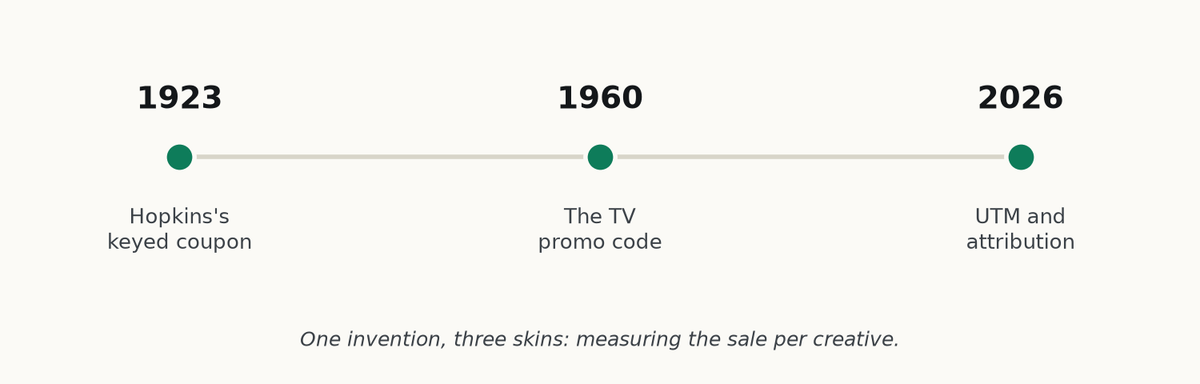
A high hook rate proves you stopped the scroll. It does not prove you banked a dollar.
That is the missing link in every article about creative: they stop at attention. Closing the loop, from the hook to the attributed sale, is Hopkins's coupon modernized. That is exactly what Metrikia does: tie each creative to the revenue actually banked, not to an attention score that contradicts itself from one tool to the next. You keep the anatomy, we give you back the measurement Hopkins was already demanding in 1923. Discover Metrikia.
If You Remember Only This
A creative that converts has a skeleton of five bones: hook, single angle, proof through the mechanism, concrete detail, honesty. The format changes every couple of years, these five bones have not moved in a century. And the only judge that does not lie is neither the hook rate nor your taste: it is the sale you can actually attribute to the ad.
FAQ
What makes an ad convert? Five timeless elements: a hook that stops the scroll in the first 3 seconds, a single angle (one promise), proof through the mechanism, a concrete detail that replaces adjectives, and an honest tone that breaks the anti-ad reflex. The format is only the skin. These five parts are the skeleton.
What is a good hook rate on Facebook? Hook rate, or thumbstop, is 3-second video views divided by impressions. Below 20%, the creative is weak. Around 25% is fine, 30% and up is strong. These benchmarks vary by account and industry: use them to compare your own creatives, not as absolute truth.
What is the difference between hook rate and hold rate? Hook rate measures attention captured in the first 3 seconds. Hold rate measures how many stay after. Careful: hold rate has two competing industry definitions (ThruPlay-based or 15-second-based), so two tools can show two numbers for the same video. Neither measures a sale.
What is a USP (unique selling proposition)? Rosser Reeves's concept (1961): a precise promise, unique (one the competition cannot or does not offer), and strong enough to move the masses. Canonical example: M&M's "melts in your mouth, not in your hand." A creative should carry one USP, not three.
How many creatives should you test? Test your hooks separately from the body: five to ten openings for the same message. It is the highest-return lever, and it is John Caples's method since 1932. The winner shows first in the hook rate, then is confirmed by the only metric that matters: revenue actually attributed.
Do the old advertising rules still hold in 2026? Yes, more than ever. The format changed, not the psychology of attention and proof. Ogilvy on the weight of the headline, Hopkins on demonstrating the mechanism, Reeves on uniqueness, Bernbach on honesty: each principle transposes line for line into a vertical video.
References
Hopkins, C. C. (1923). Scientific Advertising. https://www.garynorth.com/Hopkins-ScientificAdvertising.pdf
Ogilvy, D. (1963). Confessions of an Advertising Man. (Line reprised in Ogilvy on Advertising, 1983.)
Reeves, R. (1961). Reality in Advertising. https://brandingstrategyinsider.com/the-unique-selling-proposition-defined/
Caples, J. (1932). Tested Advertising Methods. https://en.wikipedia.org/wiki/John_Caples
Schwartz, E. (1966). Breakthrough Advertising.
Advertising Age (1999). The Advertising Century: Think Small named best campaign. https://en.wikipedia.org/wiki/Think_Small
Baptiste Noel, co-founder of Metrikia. MSc in Clinical Neuroscience and MSc in High Performance.