
Baptiste Noel
Growth and co-founder of Metrikia
- Master en neurosciences et neuropsychologies cliniques
- Master en entraînement et optimisation de la performance
- Créateur SaaS et de contenu, 20 000+ abonnés LinkedIn
Co-founder of Metrikia, Baptiste is building a SaaS from scratch and shares the growth journey unfiltered. A former clinical-neuroscience researcher and physical-performance coach, he built then left a coaching business generating over 70,000 EUR per month before focusing on product. He writes about growth strategy, acquisition and scaling.
LinkedIn5 Prompts to Clone an 8-Figure Creative Strategist
The full system to hand your creative research to AI: decode competitors, map your real buyers, and produce ads that sell. Prompts included.
In 1948, a man opens an advertising agency in New York without ever having written a single ad in his life. Before that, he sold cookers door to door, then spent several years at George Gallup's polling institute measuring American opinion. His name is David Ogilvy, and he is about to become the most imitated adman of the century. The conviction he drilled into his teams his whole career: a good ad always starts with research. You study the product inside out, you listen to customers, you test. The idea comes after, carried by what you found.
Eighty years later, the best marketers in the world still apply that lesson. Ask any creative strategist who actually performs where their time goes, and you get the same answer: not in the creation, in the research. Picking apart what competitors run, reading thousands of reviews to grasp the real language of buyers, combing through their own performance to know what works. The brief, the clever idea, the finished video, that is the visible part and the shortest. Underneath it, there are hours of digging.
That digging is exactly what AI just industrialized. Research, the invisible layer under the creative, an AI agent can now swallow overnight: open a browser, read an ad library, scrape thousands of reviews, cross-reference the data, and hand you by morning the report that used to take you a week. What follows is the full blueprint to make it do that work, module by module, with the prompts to copy. Keep the strategy for yourself. Delegate the research.
What is AI-augmented creative strategy?
AI-augmented creative strategy means handing an AI agent the research layer of creative work, the part that eats the most time, so you can focus on judgment. In practice, the AI decodes your competitors' creative strategy from their ads, turns thousands of customer reviews into usable personas, analyzes your own performance and prepares your briefs. It does not replace the strategist, it plays the role of the junior assistant: it digs, you decide.
The distinction is sharp. An AI that writes your hooks for you produces generic work, because it has neither your taste nor your context. An AI that hands you in thirty minutes the competitive analysis that used to take you a day makes you ten times sharper. The first replaces the part where you add value. The second frees that value by swallowing the tedious part.
On the menu:
- The mindset that changes everything: AI as a junior strategist, not a replacement.
- How to decode any brand's creative strategy in one prompt.
- How to turn thousands of reviews into personas that speak your buyers' real language.
- The weekly performance report that tells you what to stop, automated.
- How to turn all that research into briefs and test-ready variations.
The mindset: AI as a junior creative strategist
Before the prompts, the right way to think about the tool, because that is what separates a real time gain from a generic content factory.
You are not hiring a creative director in your place. You are hiring a brilliant, fast, tireless junior strategist, to whom you assign precise missions and whose every deliverable you review. It fetches the data, formats it, proposes a reading. You make the call: this angle is right, that one rings false, this persona is the target, that hook goes in the bin. The AI does the first draft of the thinking, you do the thinking.
On tooling, everything below runs with an AI agent that can open a browser and read your files, like Claude's agent mode connected to your browser and your Slack. The principle holds with any equivalent agent. Keep one rule in mind throughout: always review. The agent gets things wrong, sometimes invents, over-reads. Its output is a junior strategist's draft, never a truth to publish.
Module 1: decode any competitor's creative strategy
This is the most profitable module, and the most impressive to watch run. An ad library like the Meta Ad Library exposes, for free, every ad a brand is running right now. It is a goldmine, but reading it by hand across two hundred ads takes a full day. The agent does it in minutes.
The prompt to copy:
Analyze [brand]'s creative strategy from its ad library: [paste the exact Meta Ad Library link for the brand]. Give me a structured report with: the video vs image format split, the distribution of video durations, the share of partnership creatives and the creators involved, the core message pillars, the target personas you infer from the creatives, and the top 10 ads by how long they have been running. Finish with three angles they are underusing.
One detail that changes the result: give the exact library link, not just the brand name. If you only write "go check Ridge's Ad Library," the agent often lands on the wrong page. With the direct link, it hits the right source on the first try.
What you get is the report agencies bill their clients for every month. The format split tells you what the brand is betting on. The video durations reveal their winning format. The message pillars give you their central promise. And the top ads by age, an ad that has been running for a hundred and fifty days did not survive by accident, show you what their budget has validated. You are not copying, you are mapping the terrain before you choose your angle.
Module 2: turn thousands of reviews into real personas
The best copy does not invent the buyer's language, it steals it. And that language sits in customer reviews, by the thousand, written in the exact words your prospects use in their heads. Nobody has time to read three thousand reviews. The agent does.
This module happens in two steps. First, the extraction:
Go to [product or reviews page] and extract the customer reviews into a CSV file, with the rating, the text, and the product variant. Aim for at least 2,000 reviews.
Then the synthesis, in the same conversation, from the CSV:
From this review file, build me 4 personas. For each: the main pain, the buying trigger, the number-one objection, the benefit they cite most, and above all the exact verbatims, word for word, that come up most often. Put it all in an editable document.
Ask for a document first, not a pretty deck. You want to reread it, correct it, understand which personas the brand really locks onto. That document then becomes a reusable asset: you load it as context in a project, and every future brief starts from your customers' real voice instead of your guess. Once the document is good, one last prompt turns it into a presentation for the team.
The real masterstroke is the confrontation. Compare the personas your current creatives target with the personas that come out of the reviews. The gap between the two is often the explanation for your creatives that do not perform: you are talking to someone who does not buy.
Module 3: the performance report that tells you what to stop
Knowing what others do is useless if you do not know what you do well. Most teams never coldly review their own performance. The agent turns that into a weekly reflex.
The prompt:
Analyze my content performance from last week across [LinkedIn, Instagram, YouTube, TikTok, X]. For each platform: the number of posts, the top performer, what actually drove saves and shares, and a detailed "do more of this, do less of that" with examples from my real posts.
The part that stings, and carries the value, is the "do less." A well-briefed agent does not spare you: it will tell you your generic sponsored posts underperform, that one platform is neglected, that you recycle the same format too much. Ask explicitly for the level of bluntness you want. Then wire it as a recurring task and have it send you the report on Slack every Monday. The diagnosis you had been putting off for six months becomes automatic.
Module 4: continuous competitor monitoring
Module 1's teardown looks at paid advertising. This one looks at organic, where a brand shows what it truly believes in for the long run.
The prompt:
Analyze the organic content strategy of [one or more competitors] on Instagram. For each: follower count, top reels by likes with the direct link, what they are doubling down on right now, and the format that works best for them. Finish with the gaps I could exploit.
What you are looking for are the bets. One brand pushing founder-led content, another stacking celebrity collaborations, a third building multi-phase launches. Those choices tell their strategy better than any statement. And the agent's edge is that you can dig in plain language: once the report is in, ask it "why do you think this format works for them" and it unfolds. Run it on your competitors once a month, on the brands you admire when you are hunting for inspiration.
Module 5: from research to brief
All this research is worth nothing if it dies in a folder. The last module closes the loop: it turns the material into production instructions.
The prompt, reusing everything above in the same conversation:
Using the competitor teardown, the personas from the reviews, and my performance report, write me 5 creative briefs. For each: the angle, the target persona, the opening hook, the recommended format, and the key message. Then add 10 hook variations to test, in the exact language pulled from the reviews.
Now you have what you need to produce, with no blank page, anchored in real data instead of your Monday-morning intuition. This is where the junior hands in the work and the strategist takes back over: you review the five briefs, you keep three, you rewrite two hooks, you add the one the agent would never have thought of because it does not know your brand the way you do.
The cadence: a weekly loop
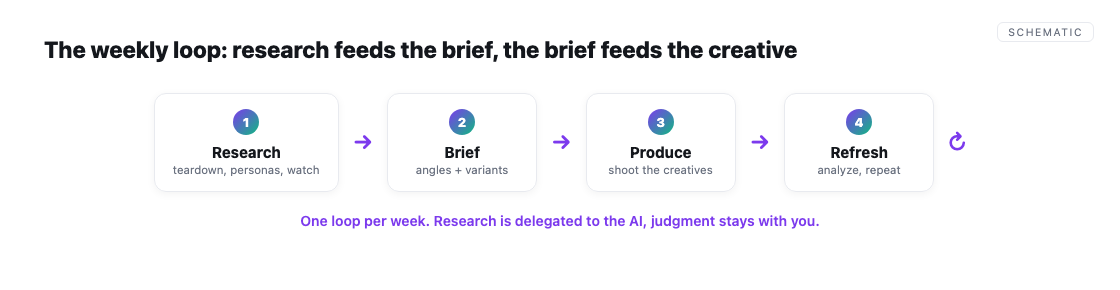
These five modules are not isolated one-offs, they are the gears of a routine. The right frequency is the week. Research on Monday, brief, produce right after, refresh. The data backs it (creative-refresh analyses across hundreds of DTC accounts): the creative refresh rate is the number-one factor separating those who decline from those who stay. Producing more, more often, backed by fresh research, beats the occasional stroke of genius. AI makes that pace sustainable for a small team, where it used to demand a whole agency.
The one question this blueprint does not answer
This system gives you a real edge: you know which angles to produce, who to talk to, and in what words. You test faster and more accurately than competitors still running on feel.
One question remains, the last one, the one that decides where your budget really goes: among all these creatives you now produce at scale, which ones actually brought in cash? Research tells you what to test. It does not tell you which one paid. For that, you have to tie each creative to the revenue actually collected, far from clicks and views. That is the job of an attribution layer like Metrikia, which ties each ad to real revenue.
Here is concretely what that changes. The platform crowns your winning creatives on clicks: the best CTR, the best completion rate, the ROAS it credits itself. Metrikia re-ranks them on the only number that counts, the revenue actually collected, tied creative by creative. And the order flips. The creative Meta crowns because it drives clicks sometimes turns out to be a cash sieve, while a quiet creative, ignored by vanity metrics, is the one really filling the bank account. That reliability on your true top creatives is what tells you which one to scale without getting it wrong.
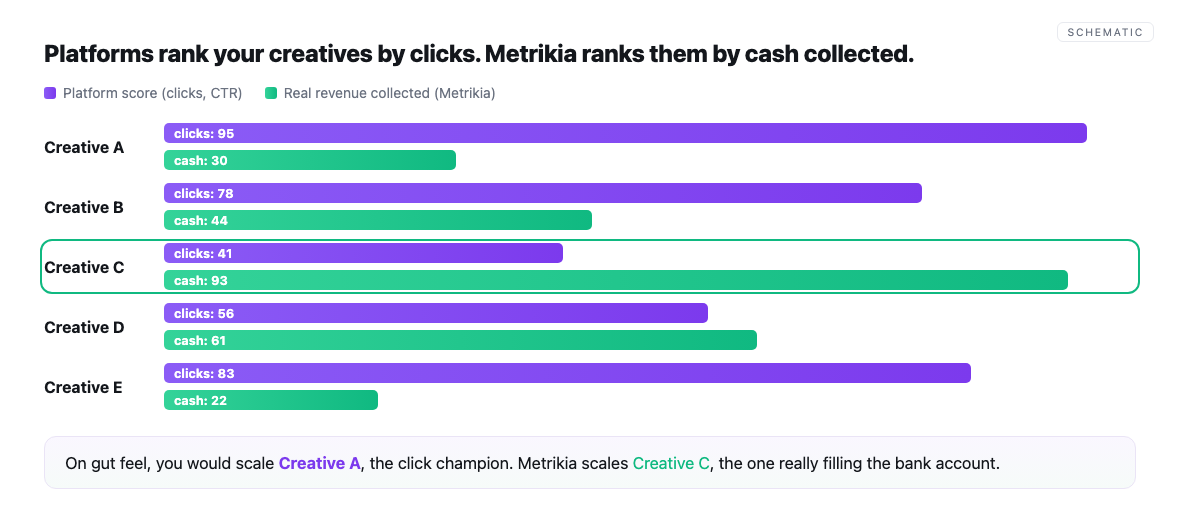
The blueprint fills the top of the chain. Attribution closes the bottom.
In three sentences
The real work of a creative strategist is research, and AI just industrialized it. An AI agent decodes your competitors, turns reviews into personas, analyzes your performance and prepares your briefs, while you keep the judgment and the angle. Only one question remains that it does not solve: which of your creatives actually made cash, and that is what attribution tells you.
FAQ
Can AI replace a creative strategist? No, and that is not the right use. It replaces the research layer, the time-consuming and repetitive part. Judgment, angle, taste, the fine understanding of your brand stay human. The right picture is a gifted junior strategist you supervise, not a replacement you let decide.
What tool runs this blueprint? An AI agent that can open a browser and read your files, like Claude's agent mode connected to your browser and your Slack. Most modules work with an equivalent agent. For persona decks, an export to a presentation tool like Canva or Gamma finishes the job.
Are these competitor analyses reliable? They are an excellent starting point, not a truth. The agent infers personas and message pillars from what is public, and it can be wrong. Review each report, cross-check, and use it as a map of the terrain, not as marching orders.
How much time does it actually save? A full competitor teardown drops from a day to a few minutes. A persona set from thousands of reviews, from a week to an hour. The gain is not marginal, it is an order of magnitude, and that is what makes a weekly cadence sustainable for a small team.
Which prompts analyze the Meta Ad Library? The Module 1 prompt: ask the agent to analyze a brand's creative strategy from the exact link to its Meta Ad Library, and return the format split, message pillars, partner creators, and top ads by run time. Always give the direct link, not just the name.
How do I extract personas from reviews with AI? In two steps (Module 2): first the agent scrapes the reviews into a CSV, then turns them into personas with the main pain, the buying trigger, and above all the exact verbatims. You get a document reusable as context for every brief.
How do I know which creative actually pays? Research tells you what to test, not what paid. You have to tie each creative to the revenue actually collected, not to clicks. A creative-level attribution layer like Metrikia re-ranks your creatives by real cash and tells you which to scale.
References
Ogilvy, D. (1983). Ogilvy on Advertising. Crown Publishers.
Meta. About the Ad Library. https://www.facebook.com/ads/library/
Baptiste Noel, co-founder of Metrikia. MSc in Clinical Neuroscience and MSc in High Performance.