
Baptiste Noel
Growth and co-founder of Metrikia
- Master en neurosciences et neuropsychologies cliniques
- Master en entraînement et optimisation de la performance
- Créateur SaaS et de contenu, 20 000+ abonnés LinkedIn
Co-founder of Metrikia, Baptiste is building a SaaS from scratch and shares the growth journey unfiltered. A former clinical-neuroscience researcher and physical-performance coach, he built then left a coaching business generating over 70,000 EUR per month before focusing on product. He writes about growth strategy, acquisition and scaling.
LinkedInPerformance Max Bills You for Customers You Already Had
Performance Max buys the people already typing your name, then bills you for the visit. What the eBay experiment measured, and how to test it on your own account.
There is a checkbox in Google Ads that has no reason to exist.
It is called a brand exclusion. You open a Performance Max campaign, you build a list, you put your own company name in it, and Google stops serving your ads to people typing your name. Right beside it, in its own documentation, Google wrote this warning: "brand settings limit the reach of a campaign and performance may decrease" (Google Ads Help, "About brand settings for Search and Performance Max").
Read that twice. An ad platform is warning you that if you stop it from selling your brand to people who were already looking for it, your results will drop.
It is right. Your reported results will drop. That is exactly where the problem starts, and it takes two sections to see why.
The short answer, before the detail
Performance Max brand cannibalization is what happens when the campaign serves on queries containing your company name. Those visitors were already looking for you. They buy, the campaign claims the sale, and your return on ad spend climbs without a single extra customer walking in. The spend is real, the conversion is real, the gain is not.
The most flattering ranking in your account
Open any Google Ads account running Performance Max alongside classic campaigns. Sort by return on ad spend. In the overwhelming majority of cases, Performance Max sits on top.
The mechanism behind that ranking is simpler than the usual telling. Automated bidding receives one instruction: find me conversions at the best possible cost. It explores, it learns, it converges. And in every ad account there is a pocket of clicks that convert better than anything else, at a trivial price, with metronome regularity: the people typing the brand name.
They are already sold. They know the product. Many have an abandoned cart sitting there. A machine asked for the best conversions-per-dollar ratio will find that pocket, and it will settle in. It does precisely what you asked of it.
Coming up:
- Where to look, in three clicks, to know whether your campaign serves on your own name
- The experiment that cost eBay tens of millions to prove the opposite of what their dashboard showed
- Why the same calculation returns over 4,100% or negative 63% depending on how you run it
- How many clicks you pay for to gain a single one, measured across thousands of brands
- What it weighs on an account spending 30,000 dollars a month
- The exact setting that shuts the tap, and the trap that quietly disables it
- The one case where cutting would cost you up to 42% of your traffic
- What to watch during the test, and why a collapse in your reported return is the sign it worked
Look first, decide second
Good news before going further: you can find out. Google shipped two reports that answer exactly this question, and most people running campaigns have only ever opened one of them.
Start with the actual queries. In the Campaigns menu, open the search terms report, then pick "Search terms and landing pages for Performance Max" from the dropdown. You get the queries that genuinely triggered your ads, their conversions, their landing pages. Segment by ad format to separate Shopping ads from text ads (Google Ads Help, "About the search terms report in Performance Max"). Search for your brand name and its variants. Add up the conversions on those rows.
Two limits Google documents itself, worth knowing before you conclude. The data goes back to March 2023, no further. And store visits are absent from it, which matters if you have physical locations.
Move on to the channel breakdown. In the same Campaigns menu, open "Insights and reports," then "channel performance." Google Search, Display, YouTube, Discover, Maps, Gmail and search partners are split out, with impressions, clicks, conversions, value and cost.
Run the number now, on your own account: the share of Performance Max conversions coming from queries that contain your name. Write it down somewhere. The better known your brand, the more likely that number is to surprise you.
You have a figure. It settles nothing at all, and that is what the rest of this article is about.
What Blake, Nosko and Tadelis found by turning off the lights
In the early 2010s, eBay was spending around 51 million dollars a year on paid search in the United States. That figure is the researchers' estimate from published spending data, to be taken as an order of magnitude. Part of that budget went to queries containing the word eBay. The dashboard was beautiful: every dollar spent came back, again and again, as attributed sales.
Three economists, Thomas Blake, Chris Nosko and Steven Tadelis, asked the question almost nobody asks. Those sales, did the advertising cause them, or did it simply watch them go by?
The only way to find out is to switch it off. In March 2012, eBay stopped buying its own brand terms on Yahoo and MSN, and watched what happened to the traffic.
The result is unambiguous. 99.5% of the lost clicks came straight back through natural search, for free. The authors put it this way: "substitution between paid and unpaid traffic was nearly complete" (Blake, Nosko & Tadelis, 2015, Econometrica). The remaining 0.5% amounted to roughly 1.5% of all paid clicks.
The explanation is one sentence of common sense. Someone typing a company name into a search engine has already decided where they are going. Block the paid door and they will take the free one sitting two centimetres below it.
Then the researchers ran the calculation that makes your head spin. Using the ordinary method, the one comparing periods and regions where spend was heavier, they get a return on investment above 4,100%. Adding day and geography controls, above 1,400%. Using the experimental variation, the one that genuinely isolates the effect of the advertising, they get negative 63%, with a 95% confidence interval running from negative 124% to negative 3%.
Same budget. Same sales. Two ways of reading them, and a gap of more than four thousand points.
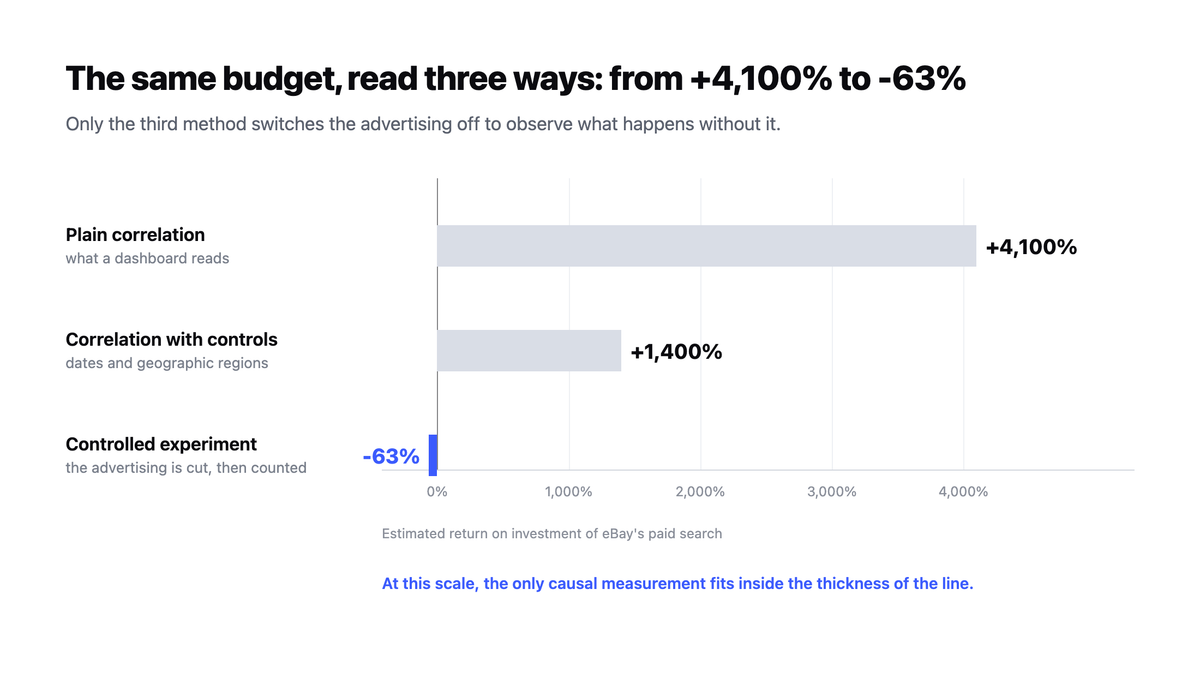
The mechanism has a name: selection bias. Brand advertising is shown precisely to the people who were going to buy. The correlation between click and purchase is therefore maximal, and the causal effect close to zero. The authors say it plainly: "Paid-search expenditures are concentrated on consumers who would shop on eBay regardless of whether they were shown ads."
One last number from the paper is worth keeping. eBay's heaviest buyers, the ones placing more than fifty orders a year, still arrived through a paid click on 4% of their purchases. Loyal customers who knew the site by heart, and for whom eBay was paying the entry fee anyway.
Sixteen clicks paid for one click gained
At this point a fair objection shows up. eBay is eBay. A brand everyone knows, with unbeatable organic ranking on its own name. What happens to an ordinary company?
The answer exists, and it is nuanced. Three researchers, Andrey Simonov, Chris Nosko and Justin Rao, ran the exercise at a completely different scale. Instead of one brand they took thousands, on Bing, and varied how many advertisers were allowed to serve on each brand query. Their work was published in Marketing Science and was a finalist for the John D. C. Little Award in 2018.
First lesson, the one that corrects eBay. With no competitor on the query, a brand ad does have a positive causal effect, but a modest one: 1% to 4% additional traffic, around 2% to 3% on average. And they find a regularity that matters to you: the better known the brand, the weaker that effect. The strongest brands in their sample behave like eBay. The smaller ones get a genuine gain.
Second lesson, the one that gives you the number to remember. Putting an ad on your own brand shifts nearly half of the free clicks onto the paid link, a movement that exceeds the real causal effect by more than a factor of ten. Translated into units your accountant understands: per 100 searches on its name, the average brand in their sample pays for 36.4 clicks and genuinely gains 2.27.
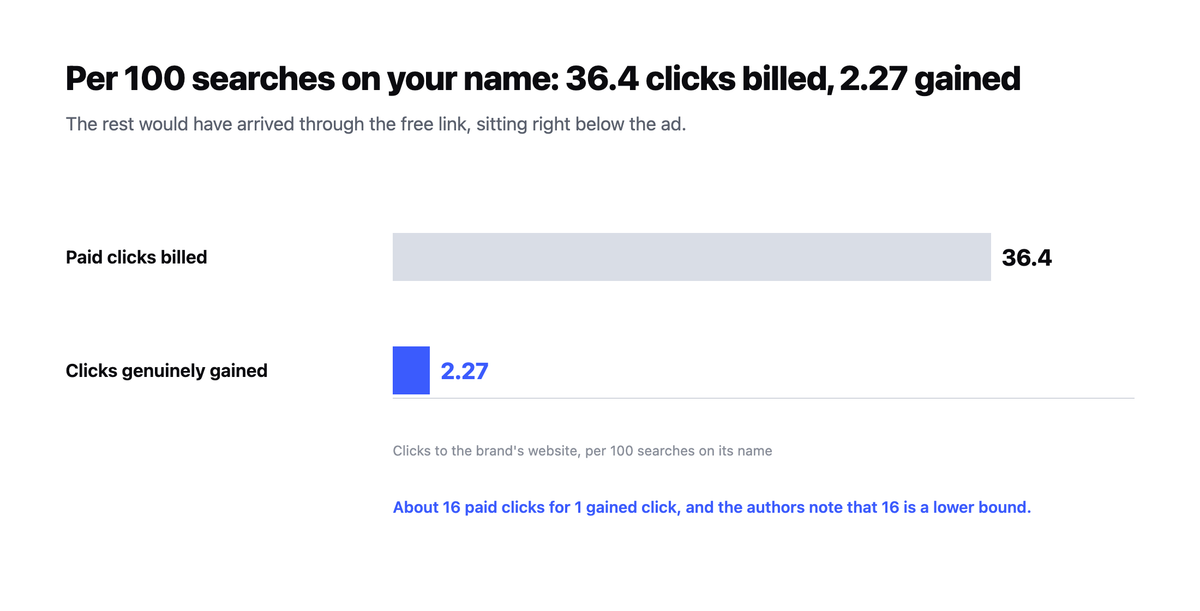
About sixteen clicks paid for one click genuinely gained. The authors take care to add that sixteen is a lower bound.
And their recommendation to marketing managers is exactly the one in this article: run ad pause experiments to measure your own cost per incremental click, instead of reading the cost per click the platform reports.
A toll gate on a road that was already there
Picture a road. It runs from a town to a shop, it has always been there, and people drive it every day because they want to go to that shop.
One day a gate goes up in the middle of the road. It builds nothing, it lays no new path, it brings nobody. It positions itself on an existing flow and takes a toll on every crossing.
At the end of the month, the gate produces its report. It counted every car, and it can prove that behind each one there was a visit to the shop. The report is honest. The cars are real, the visits are real. What the report does not say, and cannot say, is that the cars were already driving through before it existed.
The road is the people typing your name. The gate is your Performance Max campaign on brand queries. The gate's report is your reported return on ad spend. And the eBay experiment is the day someone dismantles the gate and counts the cars: exactly as many drive through.
That is what makes the search terms report insufficient on its own. It shows you the cars. It will never tell you which ones would have come without it.
What the toll gate weighs on your account
Let us move to money, because a ratio does not go into a bank account.
The calculation below is arithmetic applied to the Simonov, Nosko and Rao ratio, not a measurement taken on your account. It gives an order of magnitude, and it swings hard with how well known your brand is. Treat it as an estimate to verify, never as a result.
Take a company spending 30,000 dollars a month on Google Ads, with 20% of it landing on queries containing its name. That is 6,000 dollars a month on brand. If its profile resembles the average of the sample, roughly one sixteenth of those clicks is traffic genuinely gained. The remaining fifteen sixteenths, about 5,600 dollars a month, buy visits that would have arrived through the free link.
Over twelve months, that is around 67,000 dollars. Enough to hire someone.
Three cautions before you wave that number around in a meeting. It assumes no competitor is bidding on your name, which changes everything and gets its own section below. It assumes your brand is comparable to the average of their sample, whereas the effect is stronger for lesser known brands. And it assumes your organic result holds the top position on your own name.
So this calculation is not there to conclude. It is there to decide whether the test is worth the four weeks it asks for. At 6,000 dollars a month at stake, the answer is yes.
The setting, and the trap that cancels it
Two tools exist, and they cover different ground.
A brand exclusion is built in two steps: you create a brand list first, then apply it to your campaigns. It stops the campaign serving on queries associated with that brand, and you can put three families in it: your competitors, your partners, or your own brand. In Performance Max, it applies to Search and Shopping inventory (Google Ads Help, "About brand settings for Search and Performance Max").
Account-level negative keywords are the second tool. They apply to all Search and Shopping inventory in the account, Performance Max included, up to a thousand per account.
The trap is documented by Google and slips past almost everyone. When you pick a brand from the list, a website address appears beside the name. It only exists to tell two similarly named brands apart. It filters nothing. A team that believes it protected its domain because it saw the address on screen has protected nothing: the name does the filtering, the URL does not.
A second thing to watch, easier to miss. A brand exclusion in Performance Max only touches Search and Shopping. Your ads can keep appearing elsewhere in front of audiences who already know you, and that budget escapes the setting entirely.
The protocol, and the number that must not reassure you
Ticking the box proves nothing. It changes an allocation, and an allocation is not a measurement. Here is how to get an answer instead of an impression.
First, before touching anything, write down three numbers over the past four weeks: total company revenue, total ad spend, and the share of Performance Max conversions attributed to brand queries. The first one is the one that counts. The other two explain what moves.
Then apply the exclusion on your own brand, and leave everything else alone. No budget change, no bid change, no creative change. A test that moves two variables measures nothing.
Let it run four full weeks. Two will not do: automated bidding needs time to reallocate, and you would mostly be measuring its confusion.
And to read the result, respect this order. Total revenue first, compared with the same span before. Total spend second. Last, and only last, the return reported by the campaign.
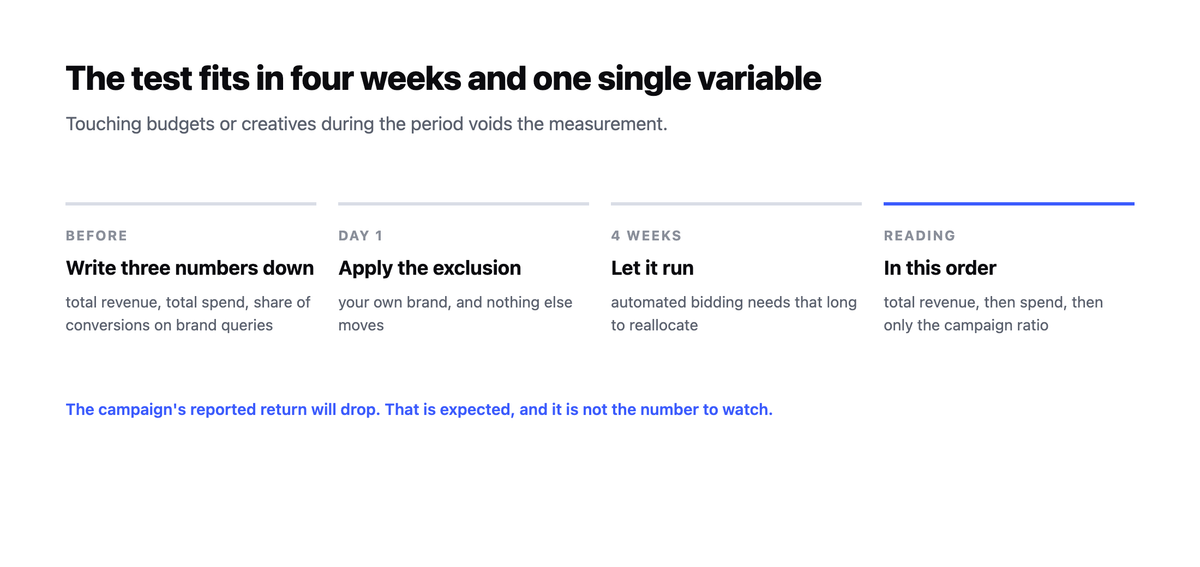
Here is what you will probably see, and the trap almost everyone falls into. The return reported by Performance Max is going to drop. Sometimes it will collapse. That is expected, and it is a good sign: you just removed the easiest conversions in the account from the campaign, the ones that made it shine at no effort.
The only question that matters sits elsewhere: did total revenue move? If it holds while spend falls, you just recovered cash. If organic search traffic on your brand absorbs the drop in paid clicks, as it did at eBay, you are not losing customers, you are simply no longer paying for the ones you had.
This reasoning is a miniature incrementality test. Its rigorous version, with a control group and geographic splits, is laid out in our article on incrementality testing and geo-lift. If the budget at stake is significant, run the rigorous version.
When this story does not apply to you
Four situations where the reasoning flips, and cutting would be a mistake.
A competitor is bidding on your name. This is the case that flips everything, and it is measured by the same paper as the section above. As long as your ad holds the top slot, a competitor sitting below it takes only 1% to 5% of your clicks. Pull your ad, and they move up: a single competitor at the top of the page then captures 18% of a large brand's traffic, and up to 42% when several of them show up. The authors are unambiguous on this specific case: the return on investment of defensive advertising is strongly positive.
In other words, the same ad is a pointless toll in one situation and an armoured door in the other. The only thing separating the two is what you see on the results page. Check it in your account's auction insights before you cut.
Your brand is young. eBay in 2012 was an institution with massive brand traffic. A two-year-old company has no such flow. There is no road to put a gate on, so nothing to cannibalize, and the exercise teaches you nothing.
Your organic result is weak on your own name. The 99.5% substitution assumes the free link sits right below. If your site ranks poorly on its own name, or if resellers and marketplaces own the top of the page, part of that traffic goes elsewhere. Look at the results page for your brand before deciding.
And a note of honesty about the experiment itself. It measures a short-term effect. It says nothing about twelve or twenty-four months, nor about what permanent visibility on your own name builds in people's heads. Any article selling you that experiment as definitive proof is lying to you.
Meta and TikTok have the same blind spot
None of this is a Google quirk.
The mechanism shows up wherever the platform picks who sees the ad and then counts the results. It has a structural reason to aim at the people most likely to buy, since that is what it is graded on. Those are precisely the people who were going to buy.
On Meta that pocket has a name everyone knows: retargeting. Visitors who already saw your products, the abandoned carts, your customer list. Those audiences post the best returns in the account, for the same reason brand queries post the best returns on Google. On TikTok, engagement audiences play the same role.
A team of researchers measured the scale of the problem across Meta. Brett Gordon, Florian Zettelmeyer, Neha Bhargava and Dan Chapsky compared, across fifteen US advertising experiments covering 500 million observations and 1.6 billion impressions, what ordinary methods say against what controlled experiments say. Their conclusion: observational methods often fail to reproduce the effect measured by the randomized experiment, even after conditioning on extensive demographic and behavioral variables (Gordon et al., 2019, Marketing Science).
Handle that with the precision it deserves. This work does not measure brand retargeting, it measures the gap between two ways of calculating. What it establishes is broader and more useful: on the large platforms, the data available to the advertiser is not enough to separate what the advertising caused from what it merely accompanied.
So the reflex carries over unchanged. On every platform, find the pocket of already-convinced audience, and test it by switching it off rather than by reading the dashboard.
The number that settles it is not in Google Ads
Everything above runs into the same wall. The search terms report, the channel breakdown, the reported return: all of it is produced by the platform, and compares the platform with itself. The gate cannot answer the question about the gate.
The only answer lives outside, in the money actually collected, tied back to its source. That is what Metrikia connects: the ad on one side, the sale banked in your CRM or your store on the other, on the same line. You then see what your revenue does while Google tells its story, and you decide on the first one.
If you want to see it on your own data, book a demo. In one session, we plug in your accounts and show you where your budget makes customers, and where it pays a toll.
Frequently asked questions
What is brand cannibalization in Performance Max? It is a Performance Max campaign serving on queries that contain your company name. Those visitors were already looking for you and would have arrived through the organic result. The campaign claims their purchase, inflating its reported return without bringing an extra customer.
How do I know if my campaign serves on my brand name? Open the Campaigns menu, then the search terms report, and select "Search terms and landing pages for Performance Max." Look for your brand and its variants, then add up their conversions. Data is available from March 2023 onward.
Should I exclude my brand from Performance Max? In most cases where the brand is established and ranks well on its own name, yes, at least long enough to run a test. Three exceptions: a young brand with no brand traffic, a competitor bidding on your name, or a weak organic result on your own brand.
What exactly do brand exclusions cover? They stop the campaign serving on queries associated with the brands in a list you build, and they cover Search and Shopping inventory in Performance Max. You can add competitors, partners or your own brand.
Brand exclusions or account-level negative keywords? A brand exclusion is applied campaign by campaign from a brand list. Account-level negative keywords apply across all Search and Shopping inventory in the account, Performance Max included, up to a thousand per account. The two work together.
Should you bid on your own brand name? The 2012 eBay experiment concludes that the organic result is a near-perfect substitute for the paid ad on brand queries, for a well-known company. The main counterargument remains defending against a competitor bidding on your name.
How many clicks do you pay for to gain one? Across thousands of brands measured on Bing, about sixteen, when no competitor is bidding on the query. Per 100 searches on its name, the average brand pays for 36.4 clicks and gains 2.27. The authors note that sixteen is a lower bound (Simonov, Nosko & Rao, 2018).
Does a small brand lose as much as a large one? No. The real causal effect of a brand ad is stronger for lesser known brands and shrinks as awareness grows. The strongest brands behave like eBay, the smaller ones genuinely gain traffic.
How much can a competitor take if I cut? As long as your ad holds the top slot, a competitor below it takes only 1% to 5% of your clicks. Without your ad, a single competitor at the top captures 18% of a large brand's traffic, and up to 42% when several compete.
How much does this represent in money? On an account spending 30,000 dollars a month with 20% going to brand queries, the order of magnitude is around 5,600 dollars a month of non-incremental clicks, close to 67,000 dollars a year. That is an arithmetic estimate built on the sixteen-to-one ratio, to be verified by a test on your own account.
Does the problem exist on Meta retargeting? The mechanism is identical: an already-convinced audience posts the best returns in the account. Fifteen experiments run at Facebook show that ordinary methods rarely reproduce the effect measured by the experiment, even with extensive demographic and behavioral variables (Gordon et al., 2019).
What exactly did the eBay experiment show? By cutting its ads on its own brand terms, eBay recovered 99.5% of the lost clicks through natural search. The return on investment of its paid search, estimated above 4,100% by the ordinary method, comes out at negative 63% under the experimental method.
Why does my return on ad spend drop after excluding my brand? Because you just removed the campaign's cheapest and most certain conversions. The fall in the reported figure is expected. What to watch is total company revenue, not the campaign ratio.
How long should the test run? Four full weeks minimum, without touching budgets, bids or creatives during the period. Two weeks mostly measures the relearning phase of automated bidding.
Does organic search really recover the lost traffic? At eBay, 99.5% of it. That figure assumes your site holds the top position on its own name. If resellers or marketplaces own the top of the page, recovery will be partial.
Does the same problem exist on Meta? The mechanism of a number produced and graded by the platform itself is the same there, with different causes. We covered it in why the ROAS Meta shows you is wrong.
How do I seriously measure the incrementality of my brand campaigns? Through a control group: a geographic split where the campaign is switched off, compared with a control region where it keeps running. The full method is in our article on incrementality testing.
References
Blake, T., Nosko, C., & Tadelis, S. (2015). Consumer heterogeneity and paid search effectiveness: A large-scale field experiment. Econometrica, 83(1), 155-174. https://doi.org/10.3982/ECTA12423
Simonov, A., Nosko, C., & Rao, J. M. (2018). Competition and crowd-out for brand keywords in sponsored search. Marketing Science, 37(2), 200-215. https://doi.org/10.1287/mksc.2017.1065
Gordon, B. R., Zettelmeyer, F., Bhargava, N., & Chapsky, D. (2019). A comparison of approaches to advertising measurement: Evidence from big field experiments at Facebook. Marketing Science, 38(2), 193-225. https://doi.org/10.1287/mksc.2018.1135
Google Ads Help. About brand settings for Search and Performance Max. https://support.google.com/google-ads/answer/13721847
Google Ads Help. How to use brand suitability features in Performance Max. https://support.google.com/google-ads/answer/13607727
Google Ads Help. About the search terms report in Performance Max. https://support.google.com/google-ads/answer/16327396
Google Ads Help. About the channel performance report for Performance Max. https://support.google.com/google-ads/answer/16260130
Google Ads Help. About account-level negative keywords. https://support.google.com/google-ads/answer/11396330
About the author
Baptiste Noel, co-founder of Metrikia. MSc in Clinical Neuroscience, MSc in High Performance.