
Baptiste Noel
Growth and co-founder of Metrikia
- Master en neurosciences et neuropsychologies cliniques
- Master en entraînement et optimisation de la performance
- Créateur SaaS et de contenu, 20 000+ abonnés LinkedIn
Co-founder of Metrikia, Baptiste is building a SaaS from scratch and shares the growth journey unfiltered. A former clinical-neuroscience researcher and physical-performance coach, he built then left a coaching business generating over 70,000 EUR per month before focusing on product. He writes about growth strategy, acquisition and scaling.
LinkedInWhy cutting your worst channel can collapse your entire revenue: MER, the guardrail metric
MER catches what per-channel ROAS hides: the interactions between channels. Why cutting a weak channel can collapse profit, and when MER itself misleads.
In the early 1900s, a Philadelphia merchant named John Wanamaker is said to have delivered the most honest sentence ever spoken about advertising: "Half the money I spend on advertising is wasted; the trouble is I don't know which half." For a century, that line haunted everyone who buys ads. Then the pixel arrived, and it promised to end it: at last, you would know which half. Every channel would have its ROAS, every euro its verdict.
The trouble is that this precision created a new blindness. By judging each channel alone, on its own ROAS, we forgot that advertising works as a system, not as a collection of independent pipes. TikTok does not convert directly, but it builds the awareness that makes your Meta campaigns convert better. Cut TikTok because its ROAS is 1.2x, and two weeks later your Meta collapses without the dashboard telling you why. You optimized a tree, and you killed the forest.
This article does not sell a tool. It sets the standard for a metric almost everyone knows by name and few use well: MER, the Marketing Efficiency Ratio. You will see what it measures, why it catches what per-channel ROAS hides, when it deceives you in turn, and how to use it with its complementary metric to decide where the next euro goes. Metrikia comes at the end, as what meets the grid.
What is MER (Marketing Efficiency Ratio)?
MER, or Marketing Efficiency Ratio, is your company's total revenue divided by all of your ad spend, across every channel, over a given period. It rests on no attribution model: no first-click, no last-click, no conversion window. It does not ask which channel produced which sale, it measures what your whole marketing machine returns, in one block. Where per-channel ROAS slices credit euro by euro and goes wrong the moment channels interact, MER captures the global result, interactions included.
It is the difference between miking each instrument in an orchestra and listening to the room. Per-channel ROAS tells you how many notes the triangle played. MER tells you whether the symphony sounds right. And it is computed from two numbers you already hold, without depending on any platform to hand them over: what you collect, and what you spend.
In this article, you will see:
- Why per-channel ROAS pushes you to sabotage the campaigns that make the others sell.
- MER explained with an orchestra, and the numbered scenario where cutting a channel destroys profit.
- mROAS, the marginal metric without which MER alone leads you astray.
- When MER deceives you in turn, and how not to fall for it.
- The decision workflow: which metric answers which question.
Why per-channel ROAS misleads you the moment there is more than one channel
Per-channel ROAS rests on an invisible assumption: that each channel produces its sales on its own, independently of the others. That assumption holds as long as you have one channel. It collapses at the second, because channels do not add up, they influence one another.
Three effects structurally escape a channel-by-channel reading. Organic uplift first: your TikTok ads build awareness, so more branded Google searches, so more direct sales no one attributes to TikTok. The halo effect next: a brand campaign with a mediocre ROAS raises the conversion rate of all your performance campaigns, and its credit is spread among the others. Cross-channel journeys last: a prospect sees your TikTok ad, searches your brand on Google, and converts three days later through an email. Each platform claims the sale or none of them sees it. Per-channel ROAS, by slicing, counts twice here and zero times there. MER, by refusing to slice, cannot be wrong about the total.
MER explained with an orchestra, and the day cutting a channel costs you
Imagine judging an orchestra by lapel-miking each musician, then dismissing the ones whose mic picks up the fewest notes. You would fire the triangle player first, who plays a single ding in the whole piece. Except that ding lands exactly at the peak of the crescendo, and without it the whole edifice rings hollow. Per-channel ROAS is the lapel mic. MER is the ear in the room: it attributes nothing to anyone, it listens to whether the whole sounds right.
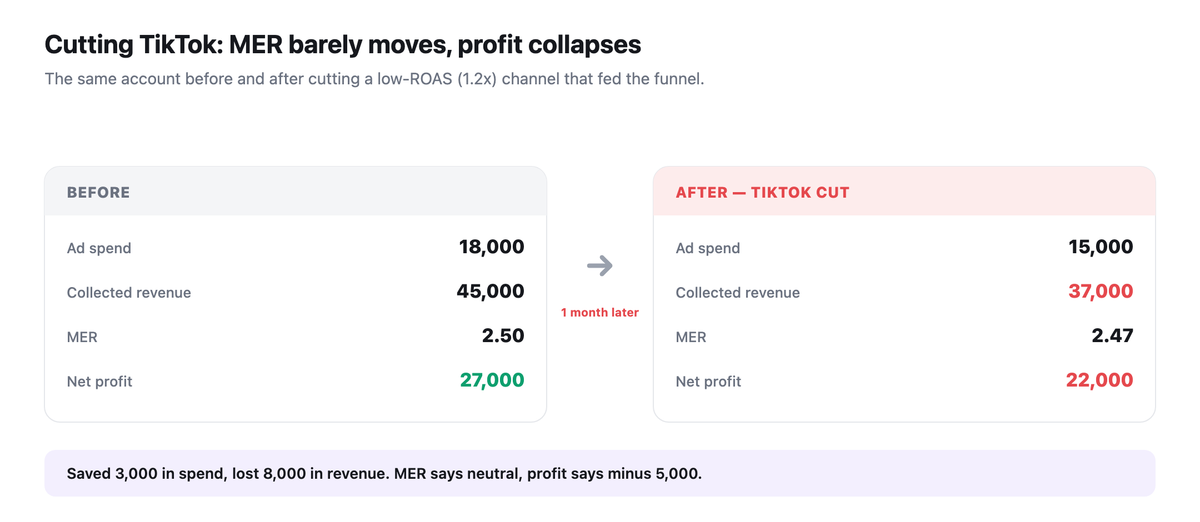
Let us make it numbered, because that is where it hurts. You spend 18,000 across all channels and you collect 45,000. Your MER is 2.5. TikTok shows a ROAS of 1.2x, below your break-even threshold. Instinctive reaction: cut it. A month later, you have saved 3,000 in TikTok spend, but your revenue has dropped to 37,000 for 15,000 of spend. MER moved to 2.47, barely a flinch, enough to think the decision was neutral. Profit tells the opposite story: it fell from 27,000 to 22,000. You saved 3,000 and lost 8,000 in revenue, 5,000 of profit gone. TikTok did not convert directly, it fed the top of the funnel; without that awareness, the Meta audiences dried up and branded search melted.
mROAS, without which MER alone leads you astray
MER has a weakness that must be named right away: it is an average. It tells you whether the entire machine is profitable, never whether you should put more or less into a given budget. For that, you need its complementary metric, mROAS, or marginal ROAS: the incremental revenue the last euro spent returned, not the average of all euros.
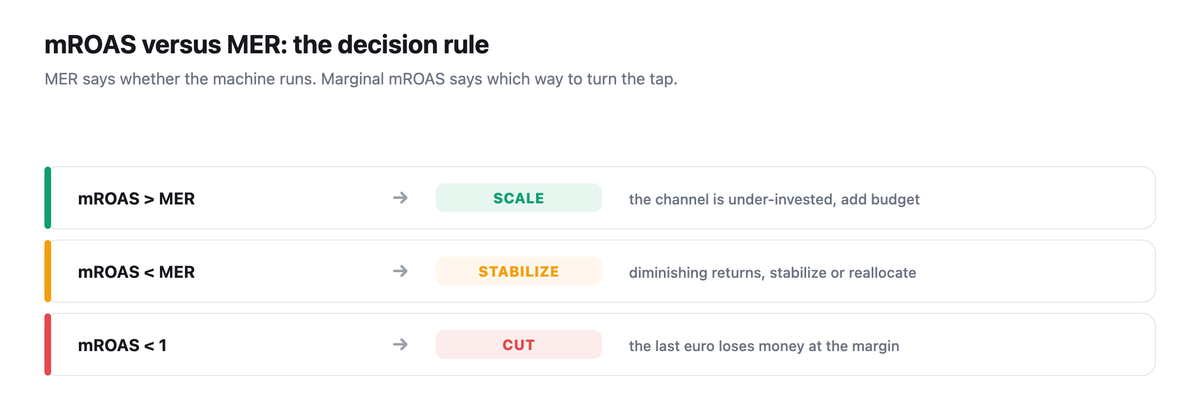
It is mROAS that answers the only operational question that matters: if I add a thousand euros to this campaign, how much more revenue, actually more? The reading rule is simple and always compares to MER. When a channel's mROAS exceeds your MER, that channel is under-invested, you can scale. When it drops below MER, you enter diminishing returns, you stabilize or reallocate. When it drops below 1, the last euro loses money at the margin, you cut. MER says whether the machine runs; mROAS says which way to turn the tap. One without the other, you steer half-blind.
When MER deceives you in turn
A misunderstood guardrail becomes a trap. MER has three blind spots to keep in mind, or it replaces one illusion with another. First, it is blind to the why: it tells you the whole is rising or falling, never which channel is responsible. Steering on MER alone is giving up on knowing where to act. Second, it credits your marketing with sales it did not produce: if your awareness climbs for an outside reason, a season, a word-of-mouth wave, a press article, MER improves and you praise your ads wrongly. Third, it can hide a dying channel behind an exploding one, as long as the average holds.
That is why MER is not the final answer, it is the guardrail one level up. It reads in triangulation: global MER for overall health, mROAS for budget decisions, your CRM's real ROAS by channel to know who truly delivers, and, when the stakes are high, an incrementality test that deliberately cuts a channel to measure its real contribution. None of these metrics is true alone. Together, they correct each other.
The decision workflow
Here is how these metrics fit together, from the broadest question to the finest. Global MER answers "is my marketing machine profitable, this week?", your weekly health check. MER by segment, by audience or geography, answers "which pockets are the most efficient?". The CRM's real ROAS by channel, computed on collected cash and not on platform estimates, answers "which channel delivers the best honest return?". And mROAS answers "should I increase or decrease this specific budget?". Any one of these questions asked without the others leads to a bad decision. Asked in this order, they turn a dashboard into a steering system.
MER in 3 sentences - MER is your total revenue divided by your total ad spend, with no attribution model: it measures the efficiency of the whole machine, cross-channel interactions included. - Per-channel ROAS, by slicing credit, pushes you to cut channels that make the others sell; MER catches that blind spot. - MER alone stays an average blind to the why: it is steered in triangulation with mROAS, CRM ROAS by channel and incrementality.
Where Metrikia sits
MER is only valuable if it is accurate, and it is only accurate if the revenue and spend it crosses are real. That is exactly what Metrikia assembles. It aggregates the spend from all your connected ad accounts, Meta, Google, TikTok, and crosses it with the revenue actually collected in your CRM, not with the conversions the platforms declare. MER is computed automatically, updated daily, readable globally and by segment, with no spreadsheet or export.
And because the same foundation carries real ROAS by channel and collected-cash tracking, you can hold the four workflow metrics in one place, on the same data: MER for health, CRM ROAS by channel for honest credit, and the material to read your marginal returns. The goal was never to display one more metric, but to give you the guardrail that keeps you from sabotaging, one morning, the channel that was making all the others sell.
Frequently asked questions
What is the difference between MER and ROAS? ROAS measures the return of a channel or campaign in isolation, from an attribution model. MER measures the return of your whole marketing machine, total revenue over total spend, with no attribution. ROAS tells you what a channel seems to return alone; MER tells you what the whole truly returns, cross-channel interactions included.
What is a good MER? There is no universal threshold, because MER depends on your margin, your share of non-paid revenue and your model. A MER of 3 can be excellent for a high-margin brand and insufficient for another. What matters is not its absolute value but its trend over time and its comparison to your real break-even, computed on collected cash.
Does MER replace per-channel ROAS? No, it complements it. MER alone is blind to which channel caused a variation. The right use is triangulation: MER for overall health, CRM ROAS by channel for real credit, mROAS for budget decisions, and incrementality to settle high-stakes cases.
What is mROAS and why is it indispensable? mROAS, or marginal ROAS, measures the incremental revenue of the last euro spent, not the average. It is what says whether to scale or cut a budget: when it exceeds MER, the channel is under-invested; when it drops below 1, the last euro loses money. MER says whether the machine is profitable, mROAS says which way to adjust.
References
Quote Investigator. (2022). One-half the money I spend for advertising is wasted, but I have never been able to decide which half (origin analysis; attribution to John Wanamaker popular but uncertain). https://quoteinvestigator.com/2022/04/11/advertising/
Meta. (n.d.). About return on ad spend (ROAS). Meta Business Help Center. https://www.facebook.com/business/help/375444268708687
Google. (n.d.). About conversion value and target ROAS. Google Ads Help. https://support.google.com/google-ads/answer/6268637
Baptiste Noel, co-founder of Metrikia. MSc in Clinical Neuroscience and MSc in High Performance.