
Baptiste Noel
Growth and co-founder of Metrikia
- Master en neurosciences et neuropsychologies cliniques
- Master en entraînement et optimisation de la performance
- Créateur SaaS et de contenu, 20 000+ abonnés LinkedIn
Co-founder of Metrikia, Baptiste is building a SaaS from scratch and shares the growth journey unfiltered. A former clinical-neuroscience researcher and physical-performance coach, he built then left a coaching business generating over 70,000 EUR per month before focusing on product. He writes about growth strategy, acquisition and scaling.
LinkedInWhy your 30 ad accounts do not speak the same language
The multi-account problem in an agency is not the tabs, it is that thirty accounts do not speak the same language. How to bring them to one common base.
Monday morning. A client calls: "So, my ads, what did they do last month?" The question is simple. To answer it, you open Meta Business Manager, the Google MCC, TikTok Ads Manager, three tabs, three numbers that do not match, and you re-glue it all by hand in a spreadsheet before calling back. You manage ten clients. You live this scene thirty times a month.
We think the problem is the number of tabs. It is not. The real problem is that your thirty accounts do not speak the same language. Each platform grades its own homework, with its own attribution window and its own claimed ROAS. When you stack these numbers in a spreadsheet, you are not aggregating data, you are adding incommensurable measurements. And the number you end up giving the client is one you will not be able to defend the day their bank account tells a different story. In an agency, your product is a number. If that number is not defensible, neither is your renewal.
This is not a new problem. In the early 1900s, as holding companies bought up dozens of firms, a wall appeared: each subsidiary kept its books its own way, and no one could read the group's real position. The answer was consolidated accounting: imposing one method so the whole became legible. Your thirty ad accounts pose exactly the same problem, and call for the same answer. This article does not sell a tool. It sets the standard for multi-account management that consolidates instead of stacking. Metrikia comes at the end, as what meets the grid.
What is structured multi-account management?
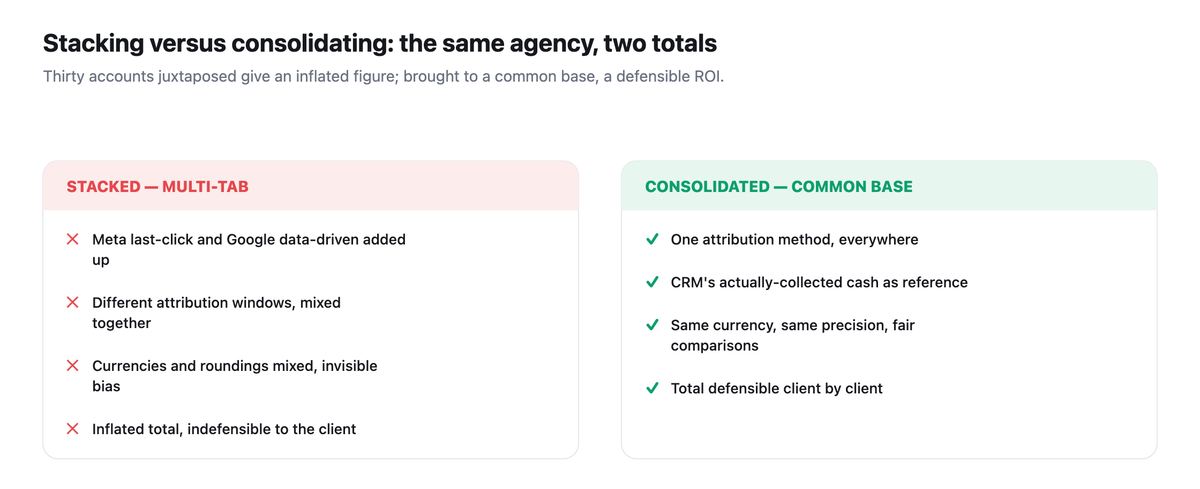
Structured multi-account management is not a dashboard that shows all your accounts in one place. It is a system that makes them comparable and summable, by bringing them to a common base: one attribution method applied everywhere, a single reference revenue, the CRM's actually-collected cash, and a hierarchy that lets you roll from the entire portfolio down to a single ad. Where multi-tab juxtaposes numbers that do not mean the same thing, structured management consolidates numbers that have become commensurable.
It is the difference between piling up thirty books written in thirty languages and having them translated into one before reading them. As long as each account speaks its own dialect, platform, window, currency, rounding, you can neither compare two clients, nor sum a portfolio, nor defend a total. Consolidation is not a display comfort, it is the condition for the number to exist at all.
In this article, you will see:
- Why the cost of multi-account is not the price of subscriptions, but time and credibility.
- What "bringing thirty accounts to a common base" concretely means.
- The consolidation hierarchy that rolls from the portfolio to a single ad.
- The trap of a consolidated dashboard laid on platform numbers: a lie at scale.
The real cost of multi-account: time and credibility
The visible cost of multi-account is the stack of subscriptions and logins. But that is not where it hurts. The first real cost is human time. An account manager compiling reports by hand can spend two hours a day on it, the equivalent of a full day a week that produces no revenue. Multiplied across a team, it is no longer a chore, it is a structural cost line that caps the number of clients the agency can hold.
The second cost is invisible and far more dangerous: credibility. When the client report is built on the numbers platforms claim for themselves, the agency presents every client with an inflated ROI that the client's cash flow will contradict sooner or later. The day an advertiser compares the flattering ROAS of their report to the cash actually collected, trust cracks, and the renewal is what breaks. An agency does not lose its clients because it has too many tabs. It loses them because it reports numbers it cannot defend.
Bringing thirty accounts to a common base
Consolidating is not juxtaposing, it is translating. Three translations are needed before a multi-account number means anything.
The first is attribution. One method, applied to all accounts and all platforms, otherwise you compare a Meta last-click to a Google data-driven and the result means nothing. The second is the reference revenue. The cash actually collected, read from the CRM and tied to the source campaign, rather than the conversions each platform declares to value itself. That is what makes a ROAS defensible to the client, because it matches what landed in the account. The third is the technical unit: amounts normalized to the same currency and the same precision, otherwise merely comparing a Meta CPA to a Google CPA happens on different roundings and introduces a bias no one sees. Once these three translations are done, and only then, the thirty accounts become one legible material.
The hierarchy that rolls from portfolio to a single ad
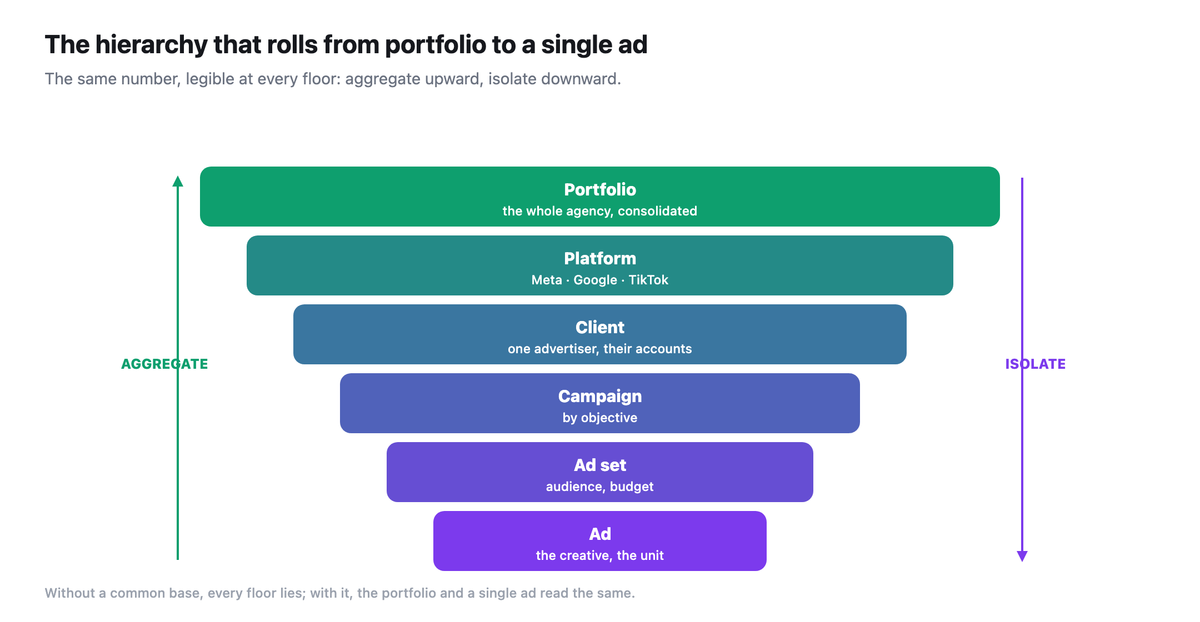
Once the accounts are commensurable, consolidation takes the form of a hierarchy you travel both ways. From the top, it aggregates: the performance of the whole portfolio, then of a platform, then of a client. From the bottom, it isolates: an account, a campaign, an ad set, a single ad. The same number, legible at every floor.
It is this hierarchy that turns agency questions into immediate answers. Which client generates the best ROI this month. Which platform is the most profitable for a given advertiser. Which campaigns burn budget without converting, across the whole portfolio. Without consolidation, each of these questions demands half a day of spreadsheet; with it, they are answered in one filter. The hierarchy does not add data, it makes the data navigable.
The trap: a consolidated dashboard laid on false numbers
Here is the trap almost every multi-account tool falls into. They succeed at the visible part, gathering everything in one place, and fail at the invisible part, the common base. A dashboard that consolidates thirty accounts by adding up the ROAS the platforms claim does not give you the truth at scale, it gives you the lie at scale, crisper and more convincing than ever.
It is the same lesson as for single-account reporting, amplified by number. Consolidation is only worth what the base it rests on is worth. Grouping incommensurable numbers produces an impressive, false total; grouping numbers brought to one attribution and collected cash produces a total you can defend client by client. And one agency-specific requirement must never be sacrificed to consolidation: isolation. Each advertiser sees their data and nothing else, each team member accesses their scope. Consolidating internally does not mean mixing everything on the client side.
Multi-account in 3 sentences - The problem is not the number of tabs, it is that thirty accounts do not speak the same language and can be neither compared nor summed. - Consolidating is translating: one attribution, collected cash as reference revenue, one currency and precision, before rolling by hierarchy. - A consolidated dashboard laid on platform numbers is a lie at scale; laid on collected cash, it is a ROI defensible client by client.
Where Metrikia sits
Metrikia was built from the start for agency operation, around this idea of a common base. You connect all your Meta, Google and TikTok accounts in one authentication, and each account is detected then synced or paused individually, without ever disconnecting it. Each account's spend is normalized to the same currency and the same precision, so cross-account comparisons carry no rounding bias.
Above all, consolidation does not rest on platform numbers but on the CRM's actually-collected revenue, tied to the source campaign, under one attribution method. The hierarchy rolls from the entire portfolio down to a single ad, isolation by client and by user is native, and the client report is generated on the true ROI, the one from closing. The goal was never to put thirty accounts on one screen, but to finally make them comparable, summable and defensible, so scaling the portfolio no longer means losing control of your numbers.
Frequently asked questions
What is the real problem of multi-account management in an agency? Not the number of tabs, but the incommensurability of the numbers. Each platform uses its own attribution, its own window and its own claimed ROAS. Stacking them in a spreadsheet produces a total that means nothing. The problem is solved by bringing all accounts to a common base: one attribution and the cash actually collected.
Why not just add up the platforms' ROAS? Because they are incompatible measurements: a Meta last-click and a Google data-driven do not sum, and each platform values itself by claiming sales. The resulting total is inflated and indefensible to the client. Only a ROI computed on collected cash, under one attribution, can be honestly consolidated.
How do you keep each client's data isolated while consolidating? Consolidation is an agency-internal use; isolation stays the rule on access. A good system separates data by advertiser and by user, so each client sees only their scope and each team member theirs, even though the agency has a consolidated view of the whole portfolio.
How much time does consolidating really save? The main gain is not compilation time, though it is real and counts in hours per day per account manager. It is credibility: a ROI defensible on collected cash protects renewals far more surely than a flattering report built on platform numbers that the client's cash flow will eventually deny.
References
Meta. (n.d.). About Business Manager and ad accounts. Meta Business Help Center. https://www.facebook.com/business/help/113163272211510
Google. (n.d.). About manager accounts (MCC). Google Ads Help. https://support.google.com/google-ads/answer/7459399
Baptiste Noel, co-founder of Metrikia. MSc in Clinical Neuroscience and MSc in High Performance.