
Baptiste Noel
Growth and co-founder of Metrikia
- Master en neurosciences et neuropsychologies cliniques
- Master en entraînement et optimisation de la performance
- Créateur SaaS et de contenu, 20 000+ abonnés LinkedIn
Co-founder of Metrikia, Baptiste is building a SaaS from scratch and shares the growth journey unfiltered. A former clinical-neuroscience researcher and physical-performance coach, he built then left a coaching business generating over 70,000 EUR per month before focusing on product. He writes about growth strategy, acquisition and scaling.
LinkedInThe CRM for a business that runs on ads: the right tags, the right tracking, real ROAS
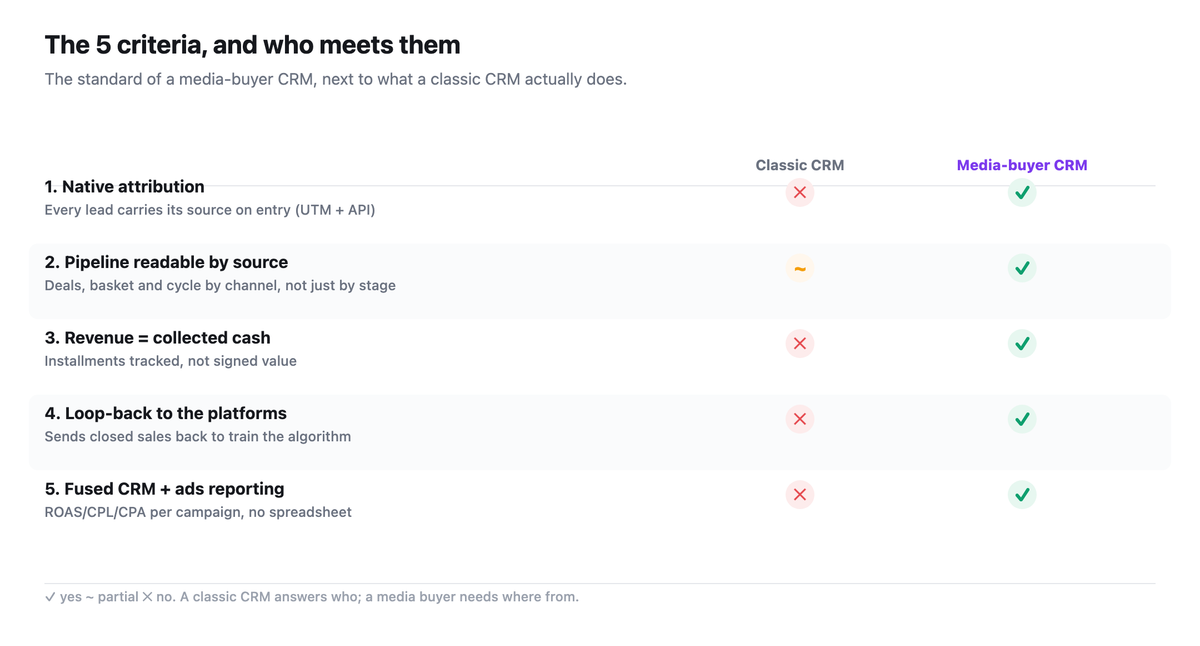
The five criteria a CRM must meet for a business that runs on ads, from tags at the source to collected cash. A grid to judge any tool, ours included.
A business that runs on advertising has a need the others do not: every euro spent on ads must be traceable to the sale it produced. Without that, you are not steering a budget, you are betting. And that is exactly where most CRMs let you down. They were built to track a customer relationship over time, not to tie a collected sale back to the ad that triggered it.
We pour energy upstream of the CRM: the pixel, server-side tracking, the Conversions API, the platform dashboards. Then we let the CRM fill itself like an address book. As a result, the most sophisticated attribution chain in the world comes crashing into a contact with no clean email and no source tag. In nine out of ten cases where attribution is off, the blocking point is neither the platform nor the pixel. It is in the CRM.
This article does not sell a tool. It sets the standard: what a contact must carry to be attributable, and the management criteria a CRM must meet in an advertising model. The right tags, the right identity, the link to the payment, tracking by source. By the end, you will have a grid to audit any tool, ours included.
Attribution does not break where you think
Follow a sale's journey. A click on a Meta ad. A visit. A form filled in. A lead entering the CRM. A call, a quote, a signature. Then, days or weeks later, a Stripe payment. Five steps, four handoffs. At each handoff, data is lost if no one welded it to the contact.
The pixel sees the click but not the signature. The CRM sees the signature but not the click. Stripe sees the payment but knows neither the campaign nor the lead. Each holds a fragment, none holds the chain. The only place these fragments can be reassembled is the contact record: it is the one object that exists from the first click to the final transfer. If that record does not carry identity, source and the link to the money all at once, no downstream tool will be able to rebuild what your ads truly earned. The CRM is the single point of failure of attribution, and almost no one treats it that way.
That is why the question is not "which is the best CRM" but "how a contact is managed inside the CRM." A brilliant tool full of dirty records attributes badly. A simple tool full of clean records attributes correctly. Attribution quality is a data-hygiene problem before it is a technology problem.
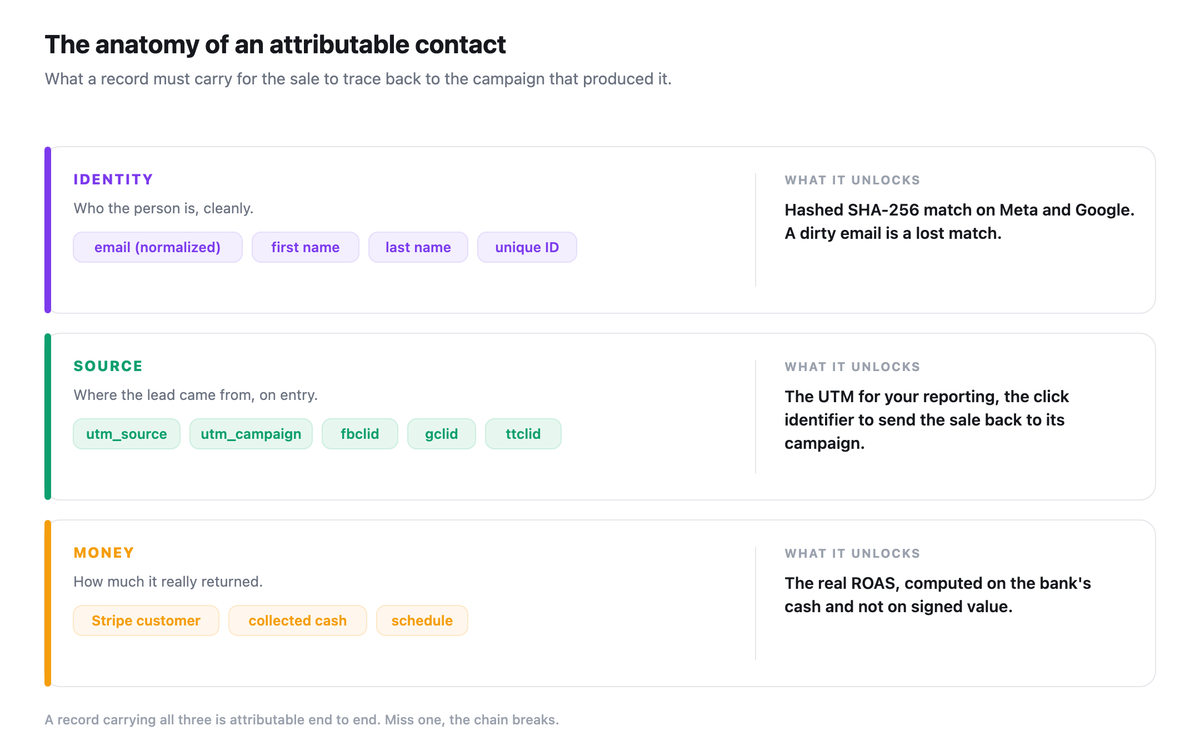
A clean identity: email, first name, last name, unique ID
To send a sale back to the right campaign, the platforms must recognize the person. They do not store your customer in the clear, they match on hashed identity data. Meta, through the Conversions API and advanced matching, matches on the email, phone, first and last name hashed in SHA-256. Google Enhanced Conversions works on the same principle with hashed first-party data. The quality of that match depends entirely on the cleanliness of what your CRM stored.
Email is the primary key. An email in uppercase, with a stray space, or entered under a different alias than the one used at click time, will not resolve to the same hash: the match fails, and the sale is never attributed to the campaign that produced it. A good CRM normalizes email on entry, lowercase, no space, in a stable format. First and last name come as backup: they are secondary matching fields that raise the match rate when email alone is not enough.
Then there is the unique ID, the field nobody talks about and that holds everything together. It is the stable identifier linking the same individual across your tools: the lead in the form, the deal in the pipeline, the customer in Stripe. Without it, you have three rows describing the same person in three systems, and no automatic way to know it is the same one. The unique ID is the thread that sews the chain. A CRM that does not generate it, or lets it diverge from one tool to another, condemns you to reconnecting your sales by hand, in a spreadsheet, which amounts to not reconnecting them at all.
Source tags: UTMs and click identifiers
A clean identity says who. Tags say where from. And there are two families of tags, often confused, though they do not serve the same purpose.
UTMs are the labels you place yourself on your links: utm_source, utm_medium, utm_campaign, utm_content. They are readable, they feed your internal reporting, and they must be captured at sign-up then stored on the contact, not merely read on the fly by the pixel. Their weakness is their fragility: a user who cleans the URL, comes back through another path, or passes through a channel that strips parameters, and the UTM disappears.
Click identifiers are of another nature. Meta's fbclid, Google's gclid, TikTok's ttclid are placed by the platform itself. They are what lets you send a conversion back to the right campaign on the platform side: Google imports offline conversions from the gclid, Meta reconstructs the fbc from the fbclid. In other words, the UTM serves your dashboard, the click identifier serves the return to the platform. A CRM built for ads captures and keeps both, on the record, from entry. Most general-purpose CRMs do not even have a field for it, and that is exactly where a sale's source evaporates.
The link to the payment: Stripe and real revenue
The third pillar is the money, and this is where most reporting lies without meaning to. A signed deal is not a paid deal. Between signature and collection lie installment payments, refunds, defaults, monthly payments landing over twelve months. A CRM that computes your performance on signed value shows you a promise. Only the cash actually arrived in the account tells the truth.
Concretely, the contact record must be linked to its Stripe customer: the customer ID, the successful payments, the running schedule. That link is what turns the word "revenue" into a real number. A four-installment plan is worth what has been collected to date, not the hoped-for total, and a good CRM knows it because it reads Stripe, not the "deal amount" field typed on signature day.
This distinction changes everything about ROAS. Optimizing on revenue promises is scaling on money you do not have yet, and sometimes never will. When the Stripe link exists and installments are tracked, your lifetime value becomes honest, and so does your ROAS. Without that link, you steer your budget on an inflated figure, and you put the most money exactly where the default rate is highest, without ever seeing it. This topic deserves its own chapter: how to count real revenue on installment payments, defaults, refunds and cohort LTV included.
The pipeline reads by source, not only by stage
Once identity, source and money are in place on each record, the pipeline changes function. The classic pipeline, Qualification, Demo, Proposal, Negotiation, Closed, describes a deal's progress. That is useful, but it answers "where is this sale," never "which campaign fills my pipeline with good sales." In an advertising model, the second question is the one that steers the budget.
A good CRM therefore adds a read by source on top of the read by stage. How many deals come from Meta, Google, TikTok. What the average basket is for leads from each campaign, because a source that brings many small baskets is not worth one that brings a few big ones. And what the sales cycle is by source, because a channel that closes in three days is not steered like one that closes in three weeks. The same pipeline, reread by origin, becomes a budgeting instrument instead of a mere sales tracker. And that reread is only possible if the source tag is clean on each record: again, everything traces back to data hygiene.
The loop-back: sending closed sales back to the platforms
A CRM built for ads should not only receive information, it should send some back. Your closed sales, the ones that live in the CRM with their identity and their click identifier, are exactly the signal that Meta, Google and TikTok's algorithms need to learn to target buyers rather than clickers. A good tool knows how to send these offline conversions back to the platforms, what is called the loop-back.
It is a criterion that separates the tools that read from the tools that act, and it is only feasible if the three previous pillars hold. Without a clean email or click identifier, you have nothing to send that the platform can recognize. A CRM that keeps your sales to itself leaves you optimizing blind. A CRM that sends them back turns your customer base into fuel for the algorithm. Few tools do it, and that is precisely what distinguishes a dashboard from a measurement system that improves performance instead of merely observing it.
Reporting fuses the CRM and the platforms
The last criterion unites the others. In a general-purpose CRM, sales data lives on one side and ad data on the other, and it is up to you to build the bridge in a spreadsheet, every week, by hand. A CRM built for ads removes that bridge by making it native: every view is already enriched with the corresponding ad figure.
Concretely, you do not consult "the leads" then "the spend" in two tabs, you see real ROAS, CPL and CPA per campaign, computed on the CRM's collected revenue and not on the platforms' estimates. It is the difference between a tool that hands you ingredients and a tool that serves you the dish. If you still have to export and re-cross the data, the reporting is not built for a business that buys advertising.
The link clean data does not save: setters and closers
You can have the cleanest schema in the world, there is still one place where attribution breaks: the human hands that handle the records. In a high-ticket business, the lead passes from a setter, who qualifies and books the appointment, to a closer, who runs the sale. Every handoff is a place where the source can drop. A setter who creates a contact by hand after an inbound call, without pasting the origin. A closer who opens a deal detached from the original lead, and the sale suddenly loses its click identifier. A merged duplicate that overwrites the good source with the bad one. A no-show never logged, and the campaign looks better than it is. The source field left empty, "we will fill it later," which never gets filled.
None of these leaks is a technology problem, they are process problems. A good CRM makes them unlikely by making the right move automatic: the source travels with the lead when the deal is created, deduplication preserves the origin instead of overwriting it, the no-show is logged in one click and reads by campaign. That is also why splitting the pipeline into two phases, setting and closing, with a view proper to each role, protects attribution: the baton passed from one role to the other carries the source, the identity and the history, instead of letting them get lost in the corridor between the two. Clean data is necessary, the process that preserves it at every hand is just as much.
How to audit your CRM in ten minutes
The theory is simple, the truth is in your records. Here is the audit to run today. Open your last twenty contacts and ask five questions of each. Is the email normalized, lowercase and without spaces? Is there a unique identifier linking this contact to its deal and its payment? Does the record carry a source, UTM and click identifier included? Is it linked to a Stripe payment, with the cash actually collected and not just the signed amount? Is the origin channel readable without you having to guess it?
Count the percentage of records that fail at least one question. That percentage is your attribution leak. It is the share of your ad budget you steer blind, however sophisticated your pixel. And in most accounts we open, that figure is far higher than one imagines, because no one ever looked at the CRM as the attribution link it is.
Where Metrikia sits
We built Metrikia around these criteria, because we wanted them for ourselves before wanting them for our clients. Identity is normalized and deduplicated on entry, email, first name, last name and unique ID, for a reliable match on the platform side. Source is captured at sign-up, UTMs and click identifiers kept on the record. Payment is read from Stripe, installments tracked one by one, for a revenue that is the bank's and not the signature's. The pipeline reads by source as much as by stage, closed sales are sent back to the platforms, and reporting fuses CRM and advertising into a single view, real ROAS, CPL and CPA per campaign, with no spreadsheet.
If you already use a CRM, Metrikia plugs into it rather than replacing it: it imports your contacts and deals, or works alongside through two-way integrations, and enriches them with the attribution layer and the payment link they were missing. The goal was never to have one more CRM. It was to have the one that answers the only question that decides your budget, where did this sale come from, and how much did it truly return.
Frequently asked questions
Why is the CRM the blocking point of attribution? Because it is the only system that exists from the first click to the final payment. The pixel sees the click but not the sale, Stripe sees the payment but not the campaign. Only the contact record can link the three, provided it carries identity, source and the payment link. If it does not, no downstream tool can rebuild what the ads returned.
Which fields must a contact carry to be attributable? A clean identity for the platform-side match, normalized email, first name, last name and a unique, stable identifier. A source, UTM for your reporting and a click identifier (fbclid, gclid, ttclid) for the return to the platform. And a link to the Stripe payment, to count the cash actually collected rather than the signed value.
What is the difference between UTMs and click identifiers? UTMs are the labels you place on your links, readable and useful to your internal reporting, but fragile. Click identifiers are placed by the platform and serve to send a conversion back so it can be attributed to the right campaign. A CRM built for ads keeps both on the record, from entry.
Should ROAS be computed on signed value or collected revenue? On collected revenue, always. Signed value is a promise that includes payments that may never arrive. That is why the Stripe link is a criterion and not a detail: it tracks the real payment, installments included, for a ROAS and a lifetime value faithful to the bank.
Can you keep your current CRM and add the attribution layer? Yes. The right approach is not necessarily to replace your CRM but to plug in a layer that normalizes identity, captures source and reads the payment, then syncs it all. What matters is that this data exists, clean, on every record, and feeds your budget decisions.
References
Meta. (n.d.). About the Conversions API. Meta Business Help Center. https://www.facebook.com/business/help/2495033933506621
Meta. (n.d.). Customer information parameters and advanced matching. Meta Business Help Center. https://www.facebook.com/business/help/611774685654668
Google. (n.d.). About enhanced conversions. Google Ads Help. https://support.google.com/google-ads/answer/9888656
Google. (n.d.). Import offline conversions from GCLID. Google Ads Help. https://support.google.com/google-ads/answer/2998031
Baptiste Noel, co-founder of Metrikia. MSc in Clinical Neuroscience and MSc in High Performance.