
Baptiste Noel
Growth and co-founder of Metrikia
- Master en neurosciences et neuropsychologies cliniques
- Master en entraînement et optimisation de la performance
- Créateur SaaS et de contenu, 20 000+ abonnés LinkedIn
Co-founder of Metrikia, Baptiste is building a SaaS from scratch and shares the growth journey unfiltered. A former clinical-neuroscience researcher and physical-performance coach, he built then left a coaching business generating over 70,000 EUR per month before focusing on product. He writes about growth strategy, acquisition and scaling.
LinkedInHow installment payments kill your attribution
Installments break attribution: the platform only learns from the first payment. How to measure real revenue at each installment, by source and cohort.
In the mid-1850s, the Singer Sewing Machine Company had a problem: it was selling a marvel of technology almost no one could afford in one payment. Its partner Edward Clark found the workaround that would change commerce worldwide: pay a little at signing, the rest a dollar a week. The sewing machine became the first expensive object ordinary households bought in installments. Consumer credit was born.
Sixty years later, the automobile industrialized the idea. In 1919, General Motors created its own financing arm so America could buy its cars on credit, and through the 1920s most of the country's automobiles sold that way, in installments. Paying over time was no longer a salesman's trick, it was the engine of modern consumption. A century on, Klarna and buy-now-pay-later put it back on every checkout page on the web, and the high-ticket economy, coaching, courses, consulting, premium SaaS, made it the absolute norm.
Selling kept up perfectly. Your order pages offer 3x, 6x, 12x without blinking. The problem is that your measurement stayed in the cash era. Your attribution tools still count a sale as a single event, happening once, at full value, on signature day. That assumption was harmless in a world of cash. The moment payment spreads over time, it silently destroys your attribution. This article explains how, and what to measure instead.
What is the attribution problem with installment payments?
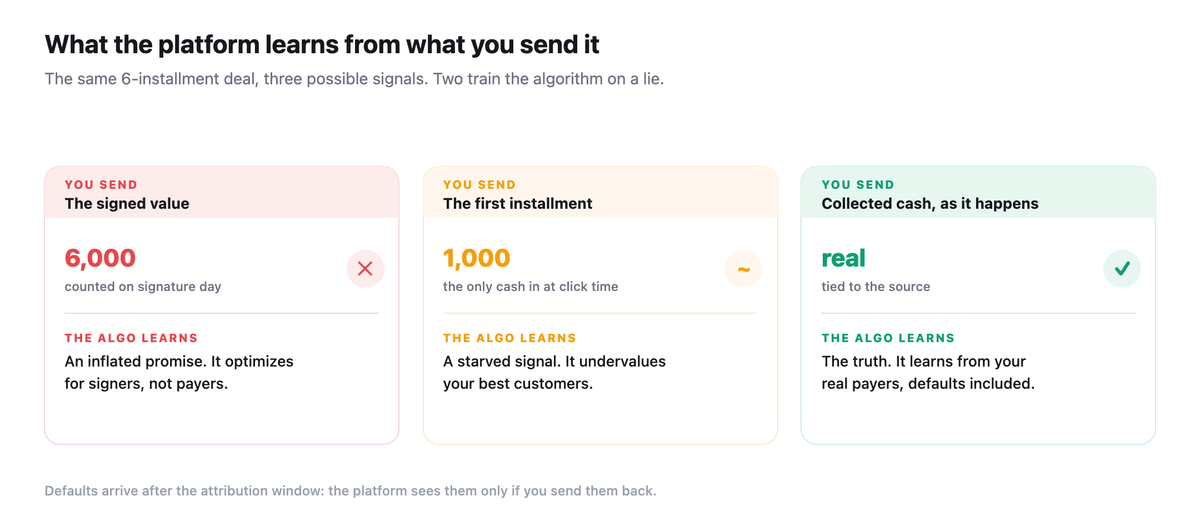
Installment payments break attribution because a sale's value is no longer a single number known at conversion time. It arrives in fragments over months, part of it never arrives, and the ad platforms that optimize your budget only ever see the first moment. So you send them either the signed value, an inflated promise, or the first installment, a starved signal, never the truth. The result: the algorithm learns from a false number, it optimizes toward the wrong customers, and your per-campaign ROAS becomes fiction.
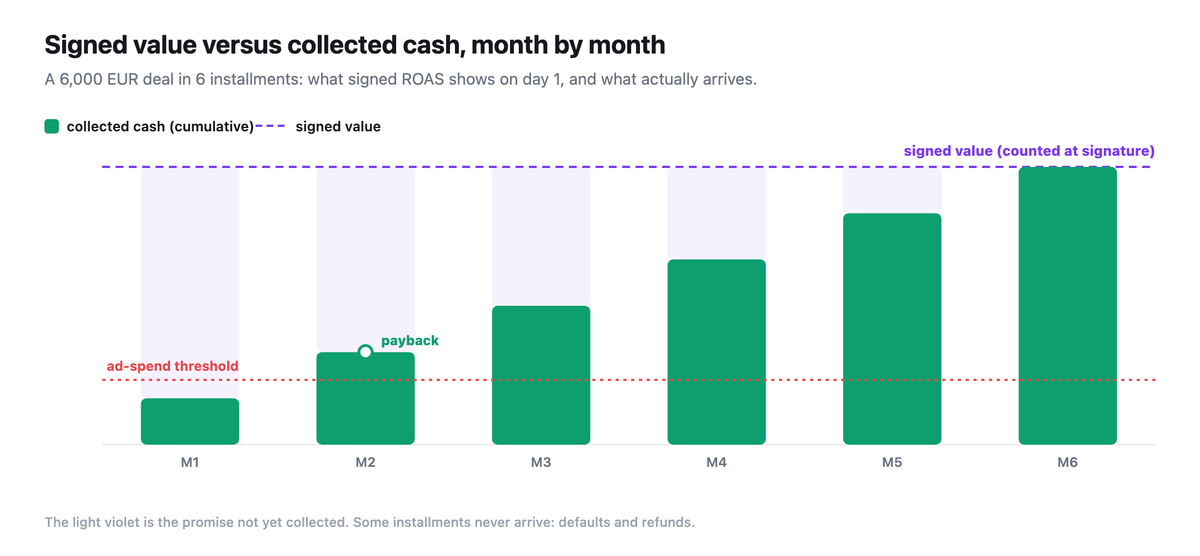
This is the difference between measuring a signature and measuring a collection. Your dashboard records the deal the day it is signed, at its stated value. The bank sees the money land in sixths over six months, minus defaults and refunds. Between the two lies the exact gap on which you make your budget decisions.
In this article, you will see where that gap comes from, why it is exploding now, how it precisely corrupts the signal you send back to the platforms, and above all what a measurement system must do to count real revenue without lying to you.
On the menu:
- The cash-era assumption that betrays all your dashboards in high-ticket.
- The signed-ROAS mirage, explained with a talent scout.
- What the platform actually learns when you send it a promise.
- The five criteria of revenue tracking faithful to the bank, not the signature.
- Payback, default rate by source and cohort LTV: the numbers that decide.
Why the problem is exploding now
For twenty years, digital attribution grew up in a world of e-commerce carts: one click, one purchase, one payment, all in minutes. In that world, counting the sale at conversion time was correct, because conversion and collection were the same event. The pixel saw the purchase, the value was known, the deal was closed.
High-ticket shattered that simultaneity. When an offer passes two thousand euros, it almost always sells in payment plans, because that is what makes it accessible. The conversion becomes the start of a six or twelve-month story, not its end. Buy-now-pay-later, generalizing fractional payment, extended that gap all the way down to average carts. Two worlds collided: a measurement built for the instant, and a sale that became stretched. No one updated the measurement, and most tools still count as if the money landed on signature day.
It is a blind spot all the more dangerous for being invisible. An inflated ROAS does not blink red. It shows a flattering number, you scale on it, and the cash-flow hole only appears months later, when the promised installments fail to show up.
The signed-ROAS mirage, explained with a scout
Imagine you run a club, and a scout brings you players. You reward the scout by the quality of the players he finds. Except you grade each player the day they arrive, on their promise, before they have played a single match. Some dazzling recruits collapse in the second month. But since you already rewarded the scout on the promise, he keeps bringing you dazzling promises, and therefore more collapses. You never told him who actually held up over the season.
The scout is the platform's algorithm. Arrival day is the conversion. The grade on the promise is the signed value you send back at click time. As long as you reward the algorithm on what the customer promised to pay, it optimizes for signers, not payers. It brings you people who say yes, not people who honor. And because defaults arrive after the attribution window, the platform never learns that a given campaign attracts customers who drop off at the third installment. It diligently builds audiences that look like your worst payers.
That is why this is not merely a cash-flow question. It is an attribution problem in the strict sense: the signal you send back to train the machine is false, so the machine learns the wrong lesson.
Under the hood: the three leaks installments open
The gap between signature and collection does not damage your measurement in one place. It opens three distinct leaks, and you have to name them to seal them.
The first is the attribution window. Platforms attribute a conversion within a fixed delay after the click, often a few days. But an installment plan's payments land over months, far outside that window. The platform sees the first moment and nothing else. Everything after, honored installments and defaults alike, happens in an angle it no longer watches.
The second is the value sent back. When you feed your conversions to the platforms, you have to transmit an amount. If you send the signed value, you train the algorithm on money that will not fully arrive. If you send only the first installment, you starve the signal and undervalue your best customers. Both choices are wrong, and most setups take the first by default, without knowing it.
The third is source detachment. Later installments arrive weeks after, often through a billing system that knows nothing of the original campaign. If the source is not welded to each collection, you know cash came in, but not which ad generated it. Your cash ROAS by campaign becomes impossible to compute. This is the junction with the rest of the chain: the CRM built for ads captures the source at lead entry and keeps it to the deal; good payment tracking extends it to the last installment.
The five criteria of revenue tracking that does not lie
Sealing these leaks is not adding a billing module, it is changing the unit you measure on. Here is the standard.
The first criterion is a change of granularity: the installment becomes the unit of measure, not the deal. A 6,000 EUR deal in six installments is not a single object, it is six distinct financial events, each with its expected amount, its theoretical date, its actual collection date and its status. Without that grain, you can neither separate promised from collected, nor see a default, nor compute when a spend is paid back.
The second criterion is two revenues shown side by side and never merged. Signed value, useful for forecasting. Collected cash, the only financial reality. From this follow two ROAS figures that must be named distinctly: signed ROAS, your potential if all is honored, and cash ROAS, your reality right now. A good system shows both; the right decision lives in the gap between them.
The third criterion is the statuses that reveal risk before it costs you. An installment moves through states, scheduled, pending, collected, failed, refunded, and these states turn your tracking into an alert system. Above all, the default rate is not randomly distributed: some sources bring customers who honor, others customers who drop off. Tracking default rate by source means discovering that a campaign with a flattering signed ROAS can be the worst once cash is counted.
The fourth criterion is realized LTV, by cohort, not promised LTV. Lifetime value is not what a customer promised, it is what they paid. Group your customers by acquisition month and track each cohort's collection curve. You then see the payback period, the number of months a cohort needs for cash to catch up with the ad spend that acquired it. A cohort can be profitable at twelve months and dangerous at three, and it is at three months that your cash flow lives.
The fifth criterion links everything else to attribution: collected cash must stay tied to its source all the way to the last installment. That is what lets you send the platforms not a promise but a real collection, as it happens, and therefore train the algorithm on payers rather than signers. Without that continuity, all the previous criteria stay a pretty cash-flow table disconnected from your budget decisions.
The problem in 3 sentences - Installment payments spread a sale's value over months, but your tools count it all at once, on signature day. - Platforms attribute only the first moment, so you train them on an inflated promise or a starved first installment, never on real cash. - Real revenue is measured at the installment, in collected cash, tied to its source, read by cohort: it is the only number a budget holds on.
Where Metrikia sits
We built Metrikia around these criteria. Each deal breaks into installments, each with its scheduled date, its collection date and its status, scheduled, pending, collected, failed, refunded. Dashboards show signed value and collected cash side by side, and compute ROAS on both bases, clearly identified. Pending or failed installments surface as alerts, so at-risk deals are visible before they become losses.
Lifetime value is computed on cash actually received, readable by acquisition cohort, so you see the payback and collection speed of each campaign month. And because every installment stays tied to its source, you can send the platforms a real collection rather than a promise, and read a cash ROAS by channel and campaign. The goal was never to add billing, but to make sure the number you decide to scale a budget on is the bank's, and that the signal you send the algorithm is that of your real payers.
Frequently asked questions
How do installment payments break attribution, and not just cash flow? Because the number you send platforms to train their algorithm is false. The conversion is counted once, at signature, while the real value arrives over months and part of it never arrives. So the algorithm optimizes toward signers, not payers, and it never sees the defaults that occur after the attribution window.
Should ROAS be computed on signed value or collected cash? On both, named distinctly. Signed ROAS measures the deal's potential if honored, cash ROAS measures what actually arrived. Steering on potential alone scales on money you do not have; ignoring potential underestimates value already contracted. The decision lives in the gap between the two.
What is the difference between promised LTV and realized LTV? Promised LTV adds up signed deals, so payment promises. Realized LTV only adds up collected installments. A customer who signed 7,500 EUR but paid 5,500 EUR has a realized LTV of 5,500 EUR. That is the figure that should judge an acquisition channel's profitability, never the promise.
Why track payment default rate by source? Because default is not randomly distributed. Some campaigns attract customers who honor their schedules, others customers who drop off midway. A campaign with a flattering signed ROAS can become the worst once actually collected cash is counted. Default rate by source reveals that gap before it drains your account.
What is the payback period on installment payments? It is the number of months a cohort of customers needs for collected cash to catch up with the ad spend that acquired it. It reads by acquisition cohort, because a cohort can be profitable at twelve months and dangerous at three, and it is in the short term that your cash flow plays out.
References
Calder, L. (1999). Financing the American Dream: A Cultural History of Consumer Credit. Princeton University Press.
Stripe. (n.d.). How subscription and installment billing works. Stripe Docs. https://stripe.com/docs/billing
Meta. (n.d.). About conversion value and ROAS. Meta Business Help Center. https://www.facebook.com/business/help/375444268708687
Google. (n.d.). Import offline conversions. Google Ads Help. https://support.google.com/google-ads/answer/2998031
Baptiste Noel, co-founder of Metrikia. MSc in Clinical Neuroscience and MSc in High Performance.