
Baptiste Noel
Growth and co-founder of Metrikia
- Master en neurosciences et neuropsychologies cliniques
- Master en entraînement et optimisation de la performance
- Créateur SaaS et de contenu, 20 000+ abonnés LinkedIn
Co-founder of Metrikia, Baptiste is building a SaaS from scratch and shares the growth journey unfiltered. A former clinical-neuroscience researcher and physical-performance coach, he built then left a coaching business generating over 70,000 EUR per month before focusing on product. He writes about growth strategy, acquisition and scaling.
LinkedInWhy your tracking tools see the click, but never the cash
Pixel, server-side and third-party tools all stop at the lead, under the same streetlight. Why only CRM-first tracking sees the sale and the cash.
There is an old story researchers tell. A man is searching for his keys on all fours under a streetlight. A passerby helps him, searches without success, then finally asks: "Are you sure you lost them here?" The man answers: "No, I lost them in the park. But here, at least, there is light." Statisticians call it the streetlight effect: you search where it is lit, not where the answer is.
Your ad tracking stack does exactly that. The pixel, the conversion API, the third-party tools, all crowd under the same streetlight: the click and the web event. That is where the light is, because it is easy to measure, instant, already instrumented. The trouble is that your keys are not there. The real sale, the one that closes after three appointments and gets collected in installments, happens in the dark, far from the lamppost, in your CRM and in your bank account. And none of these tools leaves the pool of light to go find it.
This article does not sell a tool. It explains why the classic categories of tracking tools all stop at the same place, what each one sees and what it ignores, and what a tracking that follows the journey to the cash must do. Metrikia comes at the end, as what meets the grid.
Why are classic tracking tools no longer enough?
Classic ad tracking tools are no longer enough because they measure a web event, the click, the pageview, the form, and stop where the sales journey truly begins. They see that a lead came in, never whether it was qualified, what it signed, how much it actually paid, nor whether it came back to buy. Since the end of individual tracking post-iOS 14.5 and under GDPR constraints, this snapshot of the top of funnel alone is both increasingly blurry and increasingly disconnected from revenue. Tracking that is enough today ties the ad seen to the cash collected, not to the click.
It is the difference between counting who walks into the store and counting who leaves with a paid purchase. The pixel can open the door and tell you a figure passed through. It does not know whether they bought, what they paid, or whether the check bounced. Yet to decide where to put your budget, that is the only thing that matters.
In this article, you will see:
- The three forces that made classic tracking insufficient.
- What each family of tools sees and ignores: pixel, server-side, third-party tools.
- Why they all stop at the web event, under the same streetlight.
- What changes with tracking that takes the CRM as its source of truth.
The three forces that moved the problem
Ad tracking did not degrade by accident. Three forces converged. The first is the end of individual tracking: since iOS 14.5 and the scheduled disappearance of third-party cookies, the pixel sees only a fraction of what happens after the click. The second is regulatory: GDPR requires consent, which further reduces available data and forbids certain workaround techniques. The third is structural: purchase journeys now cross several platforms, so a conversion seen by Meta may have been prepared by TikTok and closed through an email.
Taken together, these three forces do not only make classic tracking less accurate. They move the location of the truth. As long as the conversion was a click followed by an immediate purchase, measuring the click was enough. As soon as the sale spreads out, gets qualified and is paid in installments, the truth migrates from the browser to the CRM, and the tools that stayed under the streetlight find themselves measuring the wrong thing, better and better.
What each family of tools sees, and where it stops
Three big families of tools share the market, and each stops at the same place, the web event, by different paths.
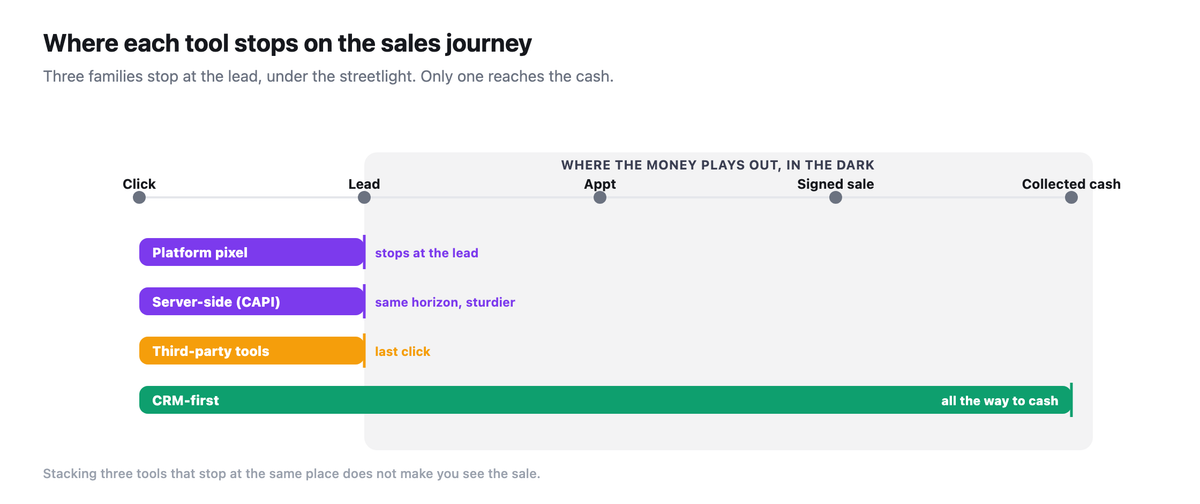
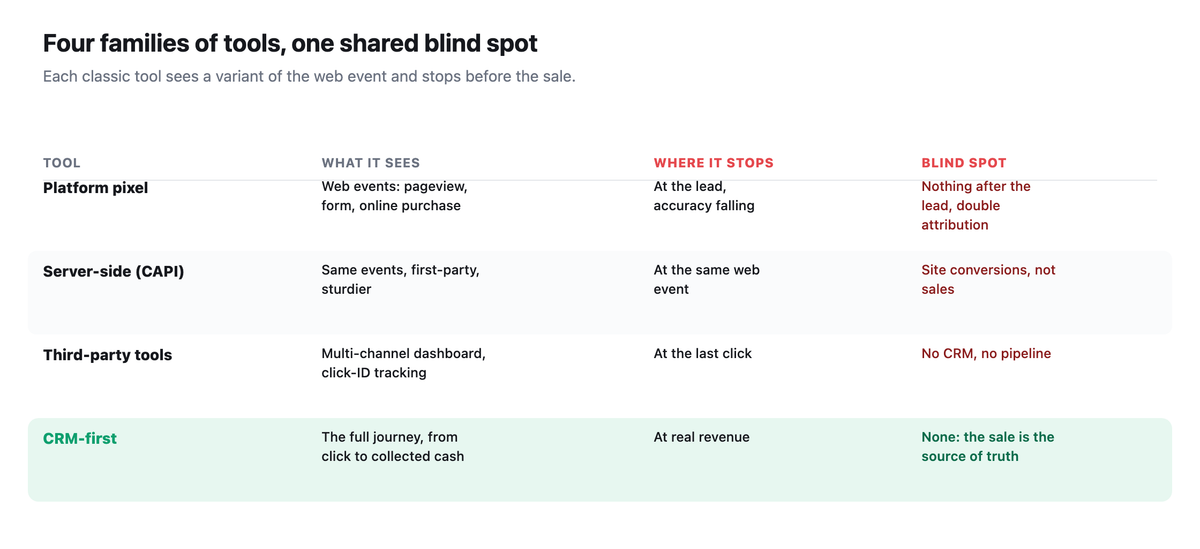
The platforms' pixels, Meta Pixel, Google Tag, TikTok Pixel, are excellent at instrumenting your site and feeding targeting: pageview, form, online purchase. But their accuracy is in free fall, each platform claims the same conversions, and above all they see nothing after the lead. Server-side tracking, via conversion APIs, fixes part of the problem: it bypasses blockers, gains accuracy and works on first-party data. But it is still built on the web event, it does not resolve cross-platform double attribution, and it measures site conversions, not real sales. Third-party tracking tools, finally, offer a multi-channel dashboard and click-ID tracking, but they most often rest on the last click, a simplistic attribution model, with no native connection to your CRM and no visibility on the pipeline. Each is good at what it does. None leaves the pool of light.
All under the same streetlight
What is striking, when you line these families up, is that they share the same blind spot. They all measure a variant of the web event, and none ties that event to what the sale actually returned. The pixel stops at the form, server-side at the same form but sturdier, the third-party tool at the last click. The journey, meanwhile, continues without them: qualification, appointment, negotiation, signature, first installment, following payments, possible refunds, repurchase. All the value plays out in that second half, the one that is in the dark.
That is why stacking these tools solves nothing. Three lamps aimed at the same sidewalk do not light the park. You get a more accurate measure of the top of funnel, and still no visibility on revenue. The question is not to measure the click better, it is to measure something else: the sale.
What tracking that sees the sale must do
Tracking that is enough today does not replace the pixel, it extends it to the end of the journey by taking the CRM as its source of truth. That requires four things. First, sync the ad platforms to know spend by campaign, ad set and ad. Then, make the CRM the result reference: qualified leads, the pipeline and collected deals are what tell the truth, not the conversions the platforms declare. Next, tie each sale to its ad source, so attribution starts from the cash and climbs back to the campaign. Finally, compute the metrics that matter, CPL, CPA and ROAS, on real revenue and not on web events.
The CRM contains exactly what the platforms do not see: whether the lead had a real need, where it stands in the cycle, how much precisely it paid, and whether it came back. It is the only base from which a performance number means anything. Not a complement to classic tracking, but its foundation.
Why classic tracking is no longer enough, in 3 sentences - The pixel, server-side and third-party tools all measure the web event and stop at the lead, under the same streetlight. - Since iOS 14.5 and GDPR, this snapshot of the top of funnel is increasingly blurry and disconnected from real revenue. - Tracking that is enough takes the CRM as its source of truth and ties the ad seen to the cash collected, not to the click.
Where Metrikia sits
Metrikia starts from the other end of the journey. Instead of tracking the click and hoping it leads somewhere, it takes the CRM as its foundation and climbs back to the ad. The ad platforms are synced for spend, the CRM carries the leads, the pipeline and the collected deals, and each sale stays tied to the campaign that produced it. The pixel and the conversion APIs do not disappear, they become the starting point of a chain that, for once, goes all the way.
The result is metrics that speak of real money: a CPL, a CPA and a ROAS computed on collected cash, a view of the pipeline tied to ad sources, and the ability to send these real sales back to the platforms so they learn. The goal was never to add one more lamp under the streetlight, but to go find your keys where you actually lost them.
Frequently asked questions
Has the Meta or Google pixel become useless? No. The pixel remains useful for instrumenting your site and feeding platform targeting. What it does not do is follow what happens after the lead: qualification, pipeline, collected sale. You should not remove it, but extend it with tracking that takes the CRM as its source of truth.
Doesn't server-side tracking solve the problem? It solves part of it, accuracy, by bypassing blockers and working on first-party data. But it is still built on the web event, not the real sale, and it does not resolve cross-platform double attribution. It is a better pixel, not revenue tracking.
Why would the CRM be a better source of truth than the platforms? Because it contains what the platforms do not see: whether the lead was qualified, where it stands in the sales cycle, how much it actually paid and whether it came back to buy. Platforms declare conversions they claim for themselves; the CRM records the cash actually collected. For a budget decision, it is the latter that counts.
Do you have to replace your current tracking tools? Not replace them, extend them. Pixels and conversion APIs keep their role at the top of funnel. What is missing is the second half of the journey: tying the ad seen to the collected deal. CRM-first tracking adds that half rather than starting from scratch.
References
Kaplan, A. (1964). The Conduct of Inquiry: Methodology for Behavioral Science. Chandler Publishing (origin of the "streetlight" parable, or drunkard's search).
Apple. (2021). App Tracking Transparency. Apple Developer Documentation. https://developer.apple.com/documentation/apptrackingtransparency
Meta. (n.d.). About the Conversions API. Meta Business Help Center. https://www.facebook.com/business/help/2495033933506621
Baptiste Noel, co-founder of Metrikia. MSc in Clinical Neuroscience and MSc in High Performance.