
Baptiste Noel
Growth and co-founder of Metrikia
- Master en neurosciences et neuropsychologies cliniques
- Master en entraînement et optimisation de la performance
- Créateur SaaS et de contenu, 20 000+ abonnés LinkedIn
Co-founder of Metrikia, Baptiste is building a SaaS from scratch and shares the growth journey unfiltered. A former clinical-neuroscience researcher and physical-performance coach, he built then left a coaching business generating over 70,000 EUR per month before focusing on product. He writes about growth strategy, acquisition and scaling.
LinkedInOffline conversions: send your CRM sales back to the ad platforms so the algorithm finds buyers
Send your CRM sales back to Meta, Google and TikTok so the algorithm learns from real buyers, not clickers. Mechanism, the three APIs, and GDPR.
An ad algorithm is a machine that learns, and like any machine that learns, it only gets good at the thing you grade it on. Tell it a filled-in form is a success, and it will become remarkable at finding people who fill in forms. It will never know which ones paid, because you never told it. The sale, the real one, closed in your CRM weeks later, in a blind spot the algorithm never saw.
That is the problem almost nobody names, because it is invisible on the dashboard. Your campaigns bring leads, cost per lead is fine, everything looks healthy. And yet revenue does not follow, because the machine has been optimizing for the wrong outcome since day one. It does exactly what it was asked. It was just asked the wrong thing.
The fix has an unglamorous technical name, offline conversions, or more tellingly, the loop-back. The idea fits in one sentence: send your real sales back to the platform so it learns, at last, from what matters. This article explains why the loop is broken, how to close it through the three return doors of Meta, Google and TikTok, and what the move actually changes, without selling you a percentage that does not exist.
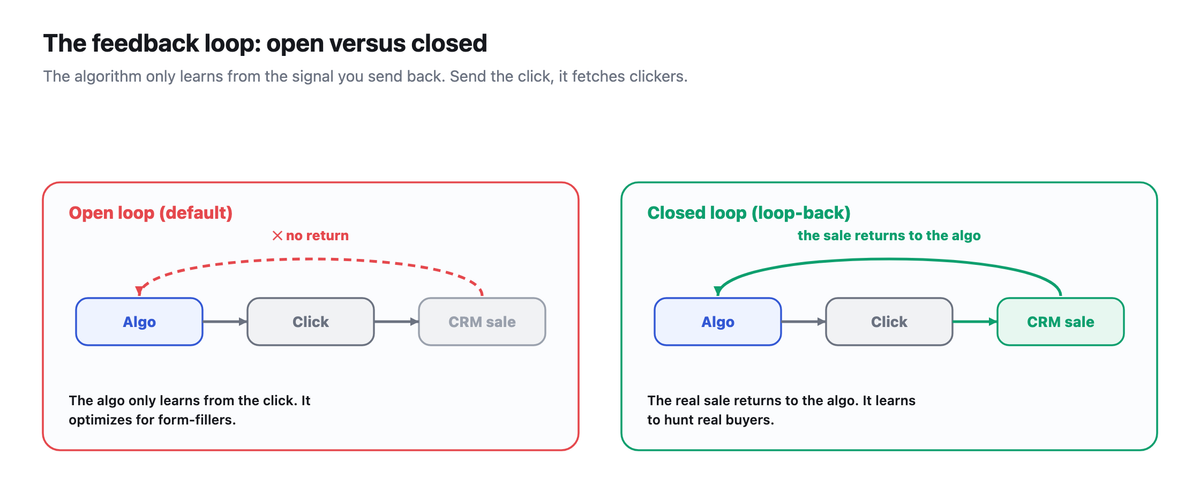
The algorithm only learns from the signal you send it back
Let us start with the mechanics, because they decide everything else. When Meta, Google or TikTok run your ads, they do not guess who to target. They learn it, from the conversions you declare to them as successes. Every event you send back, every "this one converted," is a grade that nudges the model a little further toward that kind of person. The algorithm is an eager apprentice that reproduces whatever you reward.
The trap is that most accounts only reward top-funnel signals: a click, a page view, a form submission, an add-to-cart. These are the easy events to capture, the ones that fire in the browser. So the machine trains on them and becomes an expert at producing them. It brings you form-fillers by the thousand, because that is precisely the behavior you graded as a win.
Take the GPS image. If you set your GPS to minimize the number of turns rather than travel time, it will proudly find you the straightest route, and you will arrive late. It did not fail. It perfectly executed the wrong instruction. Your ad algorithm does the same thing every time it optimizes on clicks instead of sales.
Since 2021, the loop is broken by design
There was a time when the pixel saw a reasonable share of purchases and roughly closed the loop for simple ecommerce. Apple's App Tracking Transparency, in April 2021, cut that thread for a large share of users, and the announced death of third-party cookies did the rest. But the problem runs deeper than tracking, and it was never only about ecommerce.
The moment your sale does not close in the browser, it is structurally invisible to the algorithm. A lead that signs after a call, a quote accepted three weeks later, an installment payment that lands month after month, a deal closed in a CRM: none of that exists in the world the platform observes. The machine cannot learn from an outcome it never sees. So it falls back on the last signal it has, the click, and optimizes you a funnel of the curious.
That is why cost per lead can drop while revenue stalls. These are not two anomalies, they are one cause. The feedback loop that should connect the sale to the ad is open, and as long as it stays open, the algorithm works with one hand tied behind its back.
Closing the loop: the loop-back
Closing the loop means feeding back the information that is missing. You take the real sale, where it actually lives, in your CRM or your payment processor, and you send it back to the platform that served the first impression. The machine then receives a grade of a new kind: no longer "someone clicked," but "that click became a customer who paid." And it relearns, on the right target this time.
Concretely, the move happens in four steps. You collect closed sales and collected payments from the CRM, continuously. You match each sale to the original click through a comparison on hashed personal data, email, phone or name, encrypted in SHA-256 and never sent in the clear. You send the conversion event back to the source platform through its dedicated API. And the platform reintegrates that real conversion into its model, which starts looking for profiles that resemble your buyers rather than your clickers.
Nothing in this circuit is magic. It is data plumbing, done properly. But its effect is disproportionate, because you are not changing a creative or an audience, you are changing the function the machine is trying to maximize.
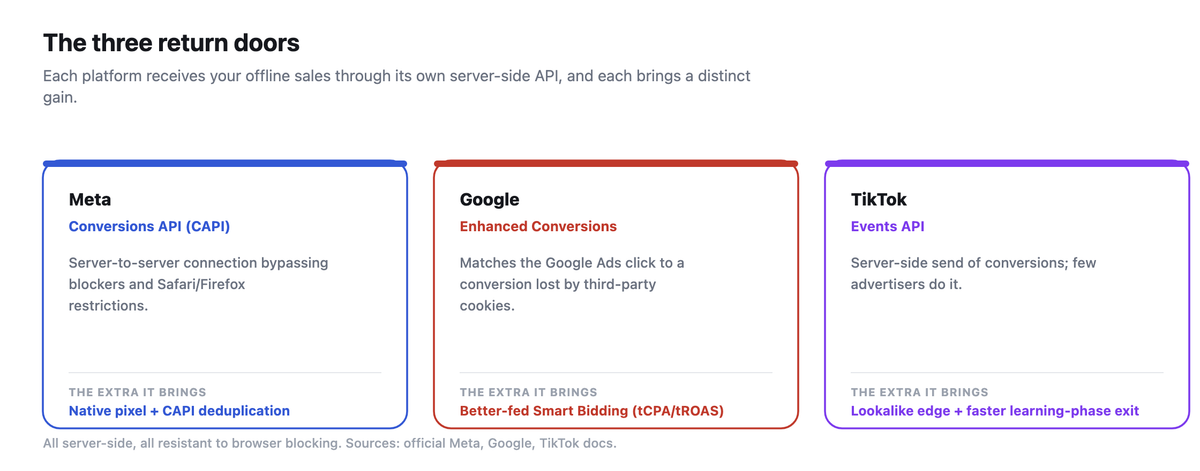
The three return doors, and what each really does
Each platform has its own door to receive your offline conversions. They are alike in spirit, server-side, resistant to browser blocking, but each brings a distinct gain worth knowing.
Meta, the Conversions API. The CAPI is a direct server-to-server connection, the opposite of the pixel that runs in the visitor's browser. Its value lies in what it bypasses: ad blockers, which erase a significant share of pixel fires, Safari and Firefox restrictions on cookies, and the silly losses from a page closed too fast or an unstable connection. Meta natively deduplicates events received through the CAPI and through the pixel, so the same purchase is not counted twice (Meta, n.d.). It is the door through which your offline sales travel to become a reliable signal again.
Google, Enhanced Conversions. Google uses the first-party data you provide, hashed email and phone, to match a Google Ads click to a conversion it would otherwise have lost with the end of third-party cookies. The real benefit is downstream: better-fed Smart Bidding. Target CPA and Target ROAS are only as good as the conversions you give them to optimize; by returning real sales, you make automated bidding more accurate (Google, n.d.). It all runs with Consent Mode v2, which transmits GDPR consent signals with each event.
TikTok, the Events API. It is the equivalent of Meta's CAPI, a server-side send of conversions. Its particular value is strategic as much as technical: few advertisers send their offline sales back to TikTok, so doing it gives you an edge your competitors lack. The platform builds better lookalike audiences from your real buyers, and its algorithm exits its learning phase faster because it receives a quality signal most never give it (TikTok, n.d.).
Reading the data, or writing into it
Here is the distinction that truly separates the tools, and almost nobody draws it. Most attribution platforms only read. They import your spend, your impressions, your clicks, they file them into beautiful dashboards, and they stop there. That is reporting: useful for understanding, inert for acting.
The loop-back belongs to the other half, the one that writes. It does not merely note that the algorithm optimizes badly, it sends back the information that corrects it. The difference between the two is not one of degree, it is one of nature. Reading is watching the machine err with better charts. Writing is changing what it learns. A tool that only reads makes you a better-informed spectator of your own waste; a tool that writes makes you an actor in the fix.
GDPR: sending sales back without betraying your customers
The loop-back means sending personal data to the platforms, and it must be done cleanly, no exceptions. The rule is simple: nothing leaves in the clear. Every matching field, email, phone, name, is hashed in SHA-256 before sending, turned into a fingerprint the platform can compare but not read back. Consent signals travel with each conversion through Google's Consent Mode v2 and the equivalent mechanisms of the other platforms, so a conversion without consent is not sent. And the matching data is purged according to your retention policy, not kept forever. Compliance is not an obstacle to the loop-back, it is a condition of doing it right.
What the loop-back changes, honestly
Let us be precise about expectations, because this is where the marketing pitch usually derails. Yes, closing the loop improves performance, often markedly, because you stop optimizing a proxy and start optimizing the outcome. But anyone who promises you a fixed number, "plus X percent ROAS," is selling false precision. The magnitude depends on your starting gap between clickers and buyers, on the size of your sales volume, and on the time given to the algorithm to relearn, usually two to four weeks before the new signal shows.
What you can expect with certainty is the direction. A machine fed your real sales looks for people who resemble your real customers. That is all, and it is enormous, because it is exactly what you wanted it to do from the start. The rest, the magnitude, is measured on your account, not in a brochure.
Closing the loop requires connecting your ad accounts and your source of truth, the CRM or payment processor, to a layer that does the matching and the sending. That is precisely the brick Metrikia operates: it collects your real sales, matches them to the original click, and sends them back to the three platforms without a line of code from you. To see where this brick fits in the whole, it is one layer of the complete tracking system, sitting on top of server-side capture through the CAPI.
Frequently asked questions
What is an offline conversion in advertising? It is a conversion that happens outside the browser, therefore invisible to the pixel: a sale closed by call, a deal signed in a CRM, a payment collected weeks after the click. Sending it back to the platform through its conversion API is the loop-back, which lets the algorithm learn from your real sales rather than your clicks alone.
What is the difference between the Conversions API and offline conversions? The Conversions API is the pipe, the server-side connection through which Meta receives events. Offline conversions are a type of event that travels through that pipe: your real sales, pulled back from the CRM. The CAPI also serves to make online conversions more reliable; the loop-back adds the conversions the browser could never see.
Does the loop-back really improve ROAS? It improves the target the algorithm looks for, which improves performance over time, because the machine starts hunting buyers rather than clickers. But the magnitude varies by account and no honest party guarantees a fixed percentage. Count two to four weeks of relearning before judging, and measure the effect on your collected sales.
Is sending personal data back to platforms GDPR-compliant? Yes, provided it is done properly: SHA-256 hashing of all matching data before sending, transmission of consent signals through Consent Mode v2 and its equivalents, and purging of data per your retention policy. A conversion without valid consent must not be sent back.
Do you need technical skills to enable offline conversions? The matching and API sending require a technical layer, but it can be fully handled by a measurement tool that connects your platforms and your CRM, with no code or tag-manager setup. The conceptual work is yours: deciding which event counts as a real conversion.
References
Google. (n.d.). About enhanced conversions. Google Ads Help. https://support.google.com/google-ads/answer/9888656
Meta. (n.d.). About the Conversions API. Meta Business Help Center. https://www.facebook.com/business/help/2495033933506621
TikTok. (n.d.). About Events API. TikTok Ads Manager Help Center. https://ads.tiktok.com/help/article/events-api
Baptiste Noel, co-founder of Metrikia. MSc in Clinical Neuroscience and MSc in High Performance.