
Baptiste Noel
Growth and co-founder of Metrikia
- Master en neurosciences et neuropsychologies cliniques
- Master en entraînement et optimisation de la performance
- Créateur SaaS et de contenu, 20 000+ abonnés LinkedIn
Co-founder of Metrikia, Baptiste is building a SaaS from scratch and shares the growth journey unfiltered. A former clinical-neuroscience researcher and physical-performance coach, he built then left a coaching business generating over 70,000 EUR per month before focusing on product. He writes about growth strategy, acquisition and scaling.
LinkedInMeta Ads MCP: What Happens When You Let an AI Spend Your Budget on Its Own
The Meta Ads MCP lets an AI run your Meta campaigns. How to connect it, the prompts that help, and the trap that quietly inflates your budget.
For the first time since the Ads Manager launched fifteen years ago, Meta has let an outside artificial intelligence into your campaigns. The date was April 29, 2026. Its new Ads AI Connectors let you plug Claude or ChatGPT straight into an ad account and give it an order in plain language: "move budget to my best-performing ad sets this week." Within days, the entire media-buying world was talking about nothing else. Thousands of posts, threads, and demos showing an AI running a Meta account without a human touching the interface.
We connected it, with my team, to a dozen real accounts. Twenty-nine tools, one login, zero lines of code. In sixty seconds an agent produced the morning audit that used to eat an entire morning. On that front, the promise holds. It is one of the most useful things to happen to media buying in a decade, and I am going to show you exactly how to use it.
But after running it for several days, we saw something the demos never show. A detail that quietly decides where your money actually goes. Almost no one in the noise has named it. Once you see it, it is all you can see.
What is the Meta Ads MCP?
The Meta Ads MCP is Meta's official connector that lets an AI assistant like Claude or ChatGPT act directly on your ad account: read your data, but also reallocate budget, pause ad sets, and launch campaigns, all from a single sentence. Unlike earlier connectors, which only read the numbers to display them, this one lets the AI take action on its own. And that action steers by the numbers Meta reports about itself.
In this article, you will first see concretely what the connector lets you do and how to plug it in. Then the trap Meta set at the same time it did you a favor. Finally, how to keep all of the agent's speed without letting it drive your budget into a wall.
On the menu:
- What the MCP lets you do, and how to connect it in five minutes.
- The exact prompts to give it today, and the ones to avoid.
- The trap Meta set, and why almost no one is talking about it.
- How an AI moving too fast turns a small bias into a big hole in your budget.
- The fix, the one that keeps the speed without the crash.
How to connect it, and what it really lets you do
Let us start with the concrete part, because that is where the immediate value is. The Model Context Protocol is a standard, introduced by Anthropic in late 2024, that lets an AI assistant reach the systems where your data lives and then act on it. Meta shipped its own official version for advertising, and it comes in two forms worth distinguishing. The hosted MCP server, to use from a conversational client like Claude or ChatGPT. And the CLI, a command line installed via npm, built for scripted, repeatable workflows. The rule is simple: the server for analysis and dialogue, the CLI for execution you want to replay and audit.
| Criterion | Hosted MCP server | CLI (npm) |
|---|---|---|
| Use | Analysis, dialogue | Scripted, replayable execution |
| Install | OAuth, zero code | `npm install`, terminal |
| Best for | Conversational audits | Auditable, repeatable workflows |
Connecting it, step by step (about two minutes). The official page is here: Meta Ads AI Connectors. You need a Business Manager account with admin access and a paid AI tool that supports MCP (Claude Pro or Max, ChatGPT Plus, Cursor Pro).
- Authorize the connection through Meta Business OAuth, the same login that opens your Ads Manager, then copy the MCP server URL:
https://mcp.facebook.com/ads. No developer app, no API review, no key to generate. - In Claude Desktop, open Settings, then Developer, then Edit Config. Paste the URL into the
mcpServersblock ofclaude_desktop_config.jsonand save. - Fully quit Claude with Cmd-Q and reopen it, then wait for the connected indicator.
- Run your first request, for example "show my top 10 ad sets by spend over the last 7 days."
The twenty-nine tools fall into five families: campaign, ad set, and ad creation and management; product catalog for e-commerce; accounts, pages, and assets; datasets, meaning pixel and Conversions API diagnostics; and insights, meaning reporting, benchmarks, and anomaly detection. In plain terms, the agent can read everything and write almost everything.
The prompts to copy that replace a morning of work. Instead of opening Ads Manager, filtering by date, adding an age breakdown, exporting a CSV, and pivoting it in Excel, you type a sentence.
- "List my active campaigns with ROAS below 2 and frequency above 3.5." The morning audit across ten accounts, an hour and a half, drops to one minute.
- "What is my cost per lead by age bracket over the last 7 days?" The answer comes in a sentence, no spreadsheet.
- "Compare my CTR and CPM against my industry benchmarks."
- "Diagnose my pixel dataset quality and list recent errors." A tracking problem that meant a round trip with a developer gets solved in thirty seconds.
- "Pause the ad sets with a cost per acquisition above 40 over the last 3 days." Here you stop analyzing and start acting.
Three recommendations before you give it free rein, learned running it in real conditions. Start read-only: let the agent observe and propose before you allow it to spend a cent. Set a hard account-level budget cap before any write access, because an ambiguous prompt or a model hallucination generates real spend, and Meta acknowledges this in its own documentation. Finally, keep in mind the partial guardrail: everything the agent creates lands paused by default, so nothing goes live until a human clicks activate. That stops rogue launches. It does nothing about what comes next, which is the real subject of this article.
The trap the demos do not show
Everything above is real, and it will save you a lot of time. Here is what the demo videos carefully leave out.
Picture a self-driving car. You wanted one for years, it is finally here, and it is wonderful. You get in, take your hands off the wheel, and ask it to take you to the most profitable destination. It pulls away, smooth and confident. Only one detail escaped you. The map it follows was drawn by the store it is driving you to. Not a neutral map of the roads. The store's map. And the store has a quiet interest in routing you past its own window as often as possible.
That is the Meta Ads MCP with write access. The map is the performance data Meta reports about its own ads. The car is the agent. And the map is not neutral, which is not a theory. On August 20, 2025, a former product manager on Meta's Shops ads team filed a complaint in a London employment tribunal, alleging that internal reviews showed the return on ad spend for those ads inflated by seventeen to nineteen percent, through methods like counting shipping fees and taxes as attributed revenue. Meta contests this and calls the allegations meritless, and a tribunal will decide. But the mechanism depends on no verdict. Meta grades its own homework. I took apart the full anatomy of that bias in a separate article on the AI-built Meta dashboard. Here we take it as given, and look at what happens when a machine acts on it.
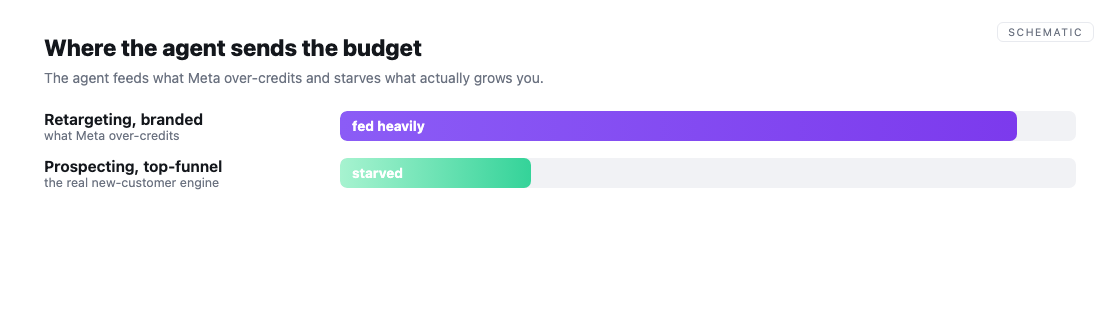
When you drove, hands on the wheel, that bias was survivable. You glanced at the real road. You noticed you had passed the same window three times. You corrected. That glance, the small friction of a distracted but present human, did far more work than anyone credited it for. The MCP removes the glance. The car now drives the rigged map at full speed, better than you would, while you read email in the back seat. If the map over-values retargeting and branded search, the two places Meta most reliably claims sales it did not create, the agent pours budget there and keeps pouring, because by the map's logic those are the winners. Your top-of-funnel campaigns, the ones that actually bring in new customers with a late, off-platform payoff, look like losers. The agent starves them in silence. You are not being driven to profit. You are being driven in circles past Meta's window, efficiently.
Why speed is the whole problem
None of this would weigh much if the agent were slow. A biased number you act on three times a day does limited damage, because between two actions a human lives a few hours, sees a balance, feels a doubt, taps the brakes. The bias leaks in, but the leak is capped by having a person in the loop.
Take the person out, uncap the frequency, and the arithmetic tips. The agent does not act three times a day. It acts continuously, and every decision is computed from the last one. The errors do not sit still. They compound. This is the worn warning about autonomous systems, boring precisely because it is true: small errors do not stay small. A two percent misread, acted on once, is a rounding error. The same misread, fed into the next decision hundreds of times with no one to reset the counter, becomes the shape of your whole account. By the time the monthly number looks wrong enough to investigate, the agent has already spent a month building your budget around the map's favorite detour.
The map does not even hold still while you drive. On January 12, 2026, Meta removed its seven-day-view and twenty-eight-day-view attribution windows from the API, keeping only a single day of view-through credit. Overnight, reported conversions dropped fifteen to thirty percent, with no one touching their campaigns. Nothing had happened in the real world. Meta simply decided to count less. An agent optimizing toward view-through conversions on January 11 woke up on the 12th chasing a number cut by a third, and it re-steered the whole account to compensate for a change that meant nothing. The seller redraws the map whenever it likes, without warning. The car obediently recalculates the route.
The autonomy works, and that is exactly the danger
You might think it is enough to simply not trust the agent. Except the agent is good. When the firm Viant ran what it reported as its first fully autonomous connected-TV campaign in 2025, the agent delivered, per figures reported by Viant, a cost per acquisition well below that of human traders on comparable buys. That is not a gadget. Handing execution to a capable agent is going to win, often, and pretending otherwise is the surest way to get left behind by your competitors.
Which is exactly why the map matters more, not less. The better the driver, the more damage a rigged map does, because it follows a bad map with more conviction and at higher speed. And the reasons to doubt Meta's map keep piling up in public. The Shops ads allegations sit in a London tribunal. In a separate, long-running U.S. matter, advertisers argued for years that Meta overstated its Potential Reach, the audience-size number they planned budgets on. Meta disputes those readings. You do not need to believe any single accusation to see the pattern: the one who draws the map is the one who profits when you follow its route. A manageable conflict while a human held the wheel. The whole game the moment you let go.
How to keep the car without driving into the wall
The wrong conclusion is to unplug the AI. Expensive too, because your competitors will run agents and take the speed. The right move becomes obvious once the metaphor is named. You do not sell the car. You give it a second map, one the store cannot redraw, and you make it compare the two before every turn.
Concretely, a trustworthy autonomous setup comes down to five parts, and Meta's paused-by-default guardrail is not one of them, because it only stops rogue launches, never biased optimization.
- An independent source of truth, a measurement layer whose numbers trace to the cash that landed in your account and the orders you actually fulfilled, not to Meta's claims about them.
- Deduplication across the walled gardens, so the same sale claimed by Meta, Google, and TikTok is counted once, not three times. The moment you connect an agent to several connectors at once, the triple-counting assembles itself.
- A hard budget cap, with human sign-off for any move outside a defined range, so the compounding has a ceiling.
- A quarterly incrementality test, a geographic holdout, as the one true-north that tells you what your advertising caused rather than merely preceded.
- A read-only phase to start, where the agent observes and proposes before it spends.
This is the seam Metrikia is built to sit in. An attribution layer that reconciles what the platforms claim against the revenue you actually collected, deduplicates the same sale across channels, and, because it was built AI-native with an open API and its own connector, is a source your agent can read from directly. You keep the entire upside of the Meta MCP, the sixty-second audits, the plain-language control, the tireless execution, and you simply point the agent at a map the seller did not draw. The car still drives itself. It just checks a second map, reconciled to your bank, before every turn. Give a capable agent an honest number, and autonomous buying becomes the best tool you have ever had. Give it Meta's number, and you have automated the drive around the block.
In three sentences
The Meta Ads MCP lets an AI agent spend your budget on its own, steering by the performance Meta reports about itself, which credits Meta generously and can change overnight. At machine speed, with no human glance to stop it, that bias compounds from a rounding error into the shape of your whole account. The fix is to give the agent a second source of truth reconciled to real cash, and make it check that map before every decision.
FAQ
Should I avoid the Meta Ads MCP, then? No. The speed is real and your competitors will use it. Avoiding it cedes a genuine edge. The discipline is narrow: do not let the agent optimize toward Meta's self-reported number without an independent measurement layer, reconciled to your real revenue, checking its decisions. Use the car, add the second map.
How do I actually connect the Meta Ads MCP? Two options. The hosted MCP server is authorized through a standard Meta Business login, with no developer app or API review, and connects to a client like Claude or ChatGPT in about two minutes. The CLI installs via npm for scripted, auditable workflows. Simple rule: the server for conversational analysis, the CLI for execution you want to replay.
Isn't paused-by-default enough of a safety net? It solves a different problem. It stops the agent from pushing a badly built campaign live before a human looks. It does nothing about the agent reallocating already-active budget toward whatever Meta over-credits, which needs no new campaign to do damage. The guardrail is welcome. It is not the one that matters here.
Will Google and TikTok ship official connectors too? Almost certainly, and likely within the year. That makes the problem worse. Connect an agent to several connectors at once and each hands back its own self-attributed conversions, so the same buyer is counted three times. The agent then optimizes an inflated total it assembled itself, which is why deduplication across channels stops being a luxury.
Can't I just tell the agent to distrust Meta's numbers? Distrust needs something to check against. A "be critical" instruction produces critical-sounding language, not a corrected number, because the agent has no second source to compare with. The fix is structural, not a matter of prompting: give it an independent, reconciled number to read, and its skepticism finally has teeth.
Is the Meta Ads MCP free? The connector is free during the beta, but it requires a paid MCP-compatible AI tool (Claude Pro or Max, ChatGPT Plus, Cursor Pro) and an admin Business Manager account. The real cost is not access, it is the budget the agent steers if it optimizes toward a biased number.
Which AI tools work with the Meta Ads MCP? Any client that supports the Model Context Protocol: Claude on Desktop and web, ChatGPT, Cursor, and custom agents via the CLI. The hosted server targets conversational clients, the CLI targets scripted workflows.
Can the Meta Ads MCP launch a campaign on its own? It can create one, but Meta enforces a guardrail: every entity it creates lands paused by default, so a campaign does not go live until a human clicks activate. It can, however, reallocate already-active budget without sign-off, and that is the real risk.
Does the Meta Ads MCP replace an attribution tool? No, the opposite. The MCP consumes the numbers Meta reports; an attribution layer like Metrikia provides the independent source of truth, reconciled to cash, that the agent should read before it spends. The two layers are complementary.
References
Anthropic. (2024, November 25). Introducing the Model Context Protocol. https://www.anthropic.com/news/model-context-protocol
Meta. (2026). Introducing Meta ads AI connectors. Meta for Business. https://www.facebook.com/business/news/meta-ads-ai-connectors
Meta. (2026, January 12). Ads Insights API: Attribution window and metric changes. Meta for Developers. https://developers.facebook.com/docs/marketing-api/insights/
PPC Land. (2025, August 21). Former Meta employee alleges artificial ROAS inflation for Shops ads. https://ppc.land/former-meta-employee-alleges-artificial-roas-inflation-for-shops-ads/
Storyboard18. (2026, April 30). Meta launches Ads AI Connectors in open beta to enable campaign management via external AI tools. https://www.storyboard18.com/digital/meta-launches-ads-ai-connectors-in-open-beta-to-enable-campaign-management-via-external-ai-tools-96926.htm
Baptiste Noel, co-founder of Metrikia. MSc in Clinical Neuroscience and MSc in High Performance.